Reflections on Pope Francis’ Message for Christian Communicators

On Friday, Pope Francis shared a message for Christian communicators marking the Memorial of Saint Frances de Sales and the 59th World Day of Social Communications. As a writer, I found his words to be both encouraging and convicting and, since so many of us write messages publicly on social media, they are widely applicable.

The Holy Father began by addressing our present times which he said are “characterized by disinformation and polarization, as a few centers of power control an unprecedented mass of data and information.” He said that, in this context, the work of Christian communicators is critical.

He went on to explain that communicators are responsible for the impact of their work on others. So often, writing is solitary work. Spending hours alone creating content, it can be easy to forget that we have obligations to others, but as Christians who are called to write, we have a unique role to play in evangelization, healing, nurturing hope, and creating (and challenging) culture. In fact, Pope Francis proposed that we have an obligation to create content that kindles hope by rejecting fearmongering, hatred, oversimplification, untruths and the weaponization of language. Our words must heal and nurture human relationships. Yet, how often do we use them “like a razor” to wound, divide or manipulate?

In his message, the Holy Father acknowledged that the task of Christian communicators is not easy. In fact, it requires us to care for our own souls and to nurture hope within ourselves. This hope comes at a cost: we must accept the reality of our situations in order to have hope that things will improve. This may mean identifying the ways that we, our families, our communities and our countries fall short which is often painful. In fact, Pope Francis quoted Georges Bernanos, “Only those are capable of hope, who have had the courage to despair of the illusions and lies in which they once found security and which they falsely mistook for hope.” But by facing reality, we learn what we have to hope for and we become familiar with the source of our hope.

Pope Francis used his message to remind readers that our hope “has a face, the face of the risen Lord.” He explained that it is through our hope in Christ that we find our own lives and writing transformed. When we create work that points to truth, to goodness and, ultimately to Him, we fulfill our purpose as Christian writers. This does not mean that everything we write must be banal or religious in nature, but it does mean that our world view, which is infused in everything we create, must be centered upon Him and His truth.

For example, consider Agatha Christie’s Hercule Poirot. Poirot is not overtly religious apart from occasional references to his attending church. However, Agatha Christie’s own Christian world view becomes apparent through her stories’ clear sense of right and wrong. Her work kindles a thirst for justice, honesty and the discovery of truth. At the same time, her books are entertaining and offer readers a chance to rest from their everyday lives, both of which are gifts that God wants His children to enjoy. While I doubt that anyone would be converted by the adventures of Hercule Poirot, they reinforce the reality that our world contains both good and evil, offer hope that what is right can win and justice can prevail, and are, therefore, morally formative, even if unconsciously so. It could even be said that they are able to convey Christian morals effectively precisely because they do so without the reader (and perhaps the writer) being aware that this is what they are doing. Good stories teach good lessons effortlessly and invisibly.

While our writing need not be blatantly religious, Pope Francis explained that our work as Christian communicators “should be steeped in gentleness and closeness, like the talk of companions on the road.” He shared his desire for our work to encourage one another, to kindle community and empathy, and to magnify what is good. When I write, I want my work to be like a stimulating conversation with a good friend that challenges, encourages and illuminates. Some of my writing explores very dark aspects of humanity, but it does so with the purpose of furthering an understanding of the real people whose exist within this darkness and, through that understanding, developing empathy. When I write about such things, I want my readers to be unsettled because it will motivate them to wrestle with the ideas that I am presenting and because such things ought to unsettle us. There are other pieces of writing that I do that are meant purely for enjoyment. This, too, points to God because it allows readers to participate in the pleasantness and beauty that God so richly pours into our days. Most often, my writing is driven by a combination of motivations, but it is always my prayer that it will honor Him.

For us to be able to create God honoring content, we must “be healed of our ‘diseases’ of self-promotion and self-absorption.” We need to recognize that we are the servants of those who consume our work and our job is to help them to find what is best in themselves as they participate more fully in community. While I suspect that most writers have allowed themselves to fantasize about speaking to an audience or landing an incredibly lucrative TV contract, the reality is that we do not write for fame or wealth. God may choose to use our writing to bless us financially, but that is only a secondary purpose. Our work’s primary purpose is to serve Him and others.

When we forget this purpose, we wade into dangerous waters. Communication is fundamentally a way of changing the world. Every word we speak or write becomes an idea that did not exist in that space before. If our work is motivated by selfishness or pride, we have the potential to create powerful and destructive weapons. When our work is directed towards self-serving goals, the consequences can be far reaching.

I am reading Jesus and John Wayne: How White Evangelicals Corrupted a Faith and Fractured a Nation by Kristin Kobes du Mez. Early in the book, the author explains that the evangelical community created a vast culture making network through various means of communication: radio, newspapers, book publishers, music, homeschool curriculums, television and the internet. The individuals who were in charge of these communications had tremendous power – often more power than those who had spent years of their life wrestling with and coming to understand theology. This power was wielded in many good ways – in fact, my own faith was deeply enriched by various aspects of this network. But it was also used to promote an understanding of Christian masculinity that involves toughness, aggression and strength – one that idolized the all American cowboy. This is one of the reasons that Jimmy Carter was not more embraced by the evangelical community: he was not a rough-and-tumble, act-before-you-think kind of guy. It is also one of the reasons why, when Jerry Falwell promoted an image of Jesus as a militant, tough guy – “a man with muscles…a he-man!” – many listeners didn’t stop and ask, “Who are you talking about?” If they had not been steeped in the culture of aggressive masculinity that evangelical communicators had created, they would have been able to recognize that the Jesus they were being fed was not the meek Savior in the Bible. Rather than asserting his dominance, focusing on his muscular physique, or becoming a fighter, that Jesus took time to speak with and heal the sick, valued being last over being first, welcomed the little children to come and rest on His knee, and displayed the absolute humility of being born in a stable and executed on a cross. They would have seen that, unlike Falwell’s Jesus, the real Jesus was victorious not through the assertion of His power and might but through the sacrifice of it in complete submission. Many were fooled into believing in a false god because words had been said, written and sung that swayed minds and changed culture in dangerous ways.

The implications of those words went beyond corrupting individual spirituality. Ultimately, it led to a nation that prioritized military might over the protection of the poor and immigrants. It contributed to the moral decay that allowed deeply religious people to overlook countless sins against women and to disregard human dignity in favor of strong-man politics and the promise of safety through aggression. In many ways, it led us to where we are today.

We have a choice whenever we sit down to write. We can advance the kingdom of God or we can act against it. We wield power with our pen (or keyboard) and we alone decide if we will use that power for good or evil. When we do our work well, we communicate the goodness that exists within our world and we help each other to become, as Pope Francis said, “a little less deaf to the cry of the poor, a little less indifferent, a little less closed in.” I want to do my work well so that when my children and grandchildren look back at history, they will know that I did everything I could to bring hope, healing and love to our broken world. I want my efforts to join others in shaping a more godly world. Mostly, I want to write faithfully so that one day Jesus will say to me, “Well done, good and faithful servant,” and I can take joy in the knowledge that my work pleased the One I love above all else.


Image: “the author” (CC BY-ND 2.0) by streetwrk.com

Quotes To Get You Through The Rest of Inauguration Week

This is the second time that Trump’s inauguration has blindsided me. The first time, I was only three months into grieving my daughter, so I will give myself a pass. This time, though, I was simply in denial. To be clear, denial is not a coping strategy that I utilize often. I’m more of a “ruminate it to death” kind of person, but apparently when my mind ran an auction to see which psychological defense mechanism would be the star of the show this January, denial was the highest bidder.

So, I peacefully meandered my way into the start of the week, thinking that I already knew that the next four years would be bad and I could not be any more disillusioned about the morality of humanity than I already was. This being the case, I assumed that nothing would come as a surprise or disappointment. However, by Trump’s sixth hour of being president, I felt both surprise and disappointment. And also visceral panic.

I will spare you of the litany of upsetting things the man has done in the past four days since he took office. If you have read this far, I trust that you already have your own list of horrors conjured in your mind. It is enough to say that my list includes blatant disregard for structures of democracy and the rule of law, suppression of knowledge, promotion of prejudice and hatefulness. Of course, all of the wrong has happened against a backdrop of a flaunted false Gospel that treats Jesus more like a tribal warrior than a wandering healer – one who, when being executed, prayed for the forgiveness of His executioners.

Still, though I have been caught off balance by the authoritarianism that has planted itself in the White House, my sense of right and wrong has been sharpened and become more acute, my opportunities to teach my children about who Jesus really is have grown exponentially, and I have been repeatedly encouraged by the thoughts and words of amazing men and women. I share the following quotes here in the hope that they may help the night to feel a little less dark for you and hope to feel a bit more real.

The first quote comes from J.R.R. Tolkien’s the Lord of the Rings. If you are familiar with the story, this quote is pulled from a scene in which Frodo has just been informed about the history of the ring and the role that he will need to play in destroying it. If you are unfamiliar with the story, I highly suggest using these cold mid-winter days to read it! Don’t be intimidated by its length – it’s worth it. It is also a wonderful story about a small, insignificant being who courageously takes on powerful evil and, through his faithfulness and determination, as well as the support of his friends, forever changes Middle Earth where he lives.

“‘I wish it need not have happened in my time,’ said Frodo. ‘So do I,’ said Gandalf, ‘and so do all who live to see such times. But that is not for them to decide. All we have to decide is what to do with the time that is given us.'” 

The second quote is from C.S. Lewis’s work On Living in an Atomic Age. As is obvious from the title, it was his response to the development of the atomic bomb, however, if you do as I have done below and replace the references to the bomb with any of our current concerns, it is very helpful. I found this quote while I was looking for another similar but different quote that I was thinking about. That one effectively said that we have to keep doing art and pursuing our passions because, if we stop, we will have nothing left to fight for. This quote is a little less lofty but similarly helpful in knowing how to live in such times.

If we are all going to be destroyed … let that (destruction) when it comes find us doing sensible and human things—praying, working, teaching, reading, listening to music, bathing the children, playing tennis, chatting to our friends over a pint and a game of darts—not huddled together like frightened sheep and thinking about (disasters). They may break our bodies (a microbe can do that) but they need not dominate our minds.

The third quote is from Heather Cox Richardson during her recent virtual talk with Red Wine and Blue. Red Wine and Blue is a grass-roots organization that promotes Democratic candidates and policies in the suburbs. While I do not agree with all of its positions, it is doing critical work in trying to protect our democracy. Heather Cox Richardson is a historian and professor at Boston College. She has been vocal about her opposition to Trump and his many dangerous and undemocratic deeds since his first term in office. Her commentaries are unique in both their breadth and the depth of historical context that she offers. I believe her quote is self-explanatory. 

“One of the really important things to remember going forward as we fear the rise of authoritarianism in the United States: authoritarians cannot rise if there are strong communities and people are acting with joy. That is, you need despair and anger in order for an authoritarian to rise…It is okay to say, ‘I’m not gonna pay attention to politics for a while,’ but it’s not okay to stop bringing your best to the world. Whatever those things are that you bring to the community, do them and do them with joy and don’t stop doing the things you love because you’re scared because that actually is a form of resistance. Showing up and doing things you love says to an authoritarian, ‘You have no place to root here.'”

The fourth quote is from a Bible study about Nabal and his insult to soon-to-be King David. The particular lesson examines righteous anger. We spend so much of our lives trying to overcome our anger, but at times like these, anger is what will drive us to pursue what is good and right, just and pure. The criteria for righteous anger that the study provides is helpful in not only affirming that it is okay to feel rage about what is happening in our country, but also in reminding us that we must not sin in the way that we respond to this anger. All of history will, ultimately, testify to God’s glory and it is to that end that we should direct all of our actions.

            “Author Robert D. Jones gives three criteria for righteous anger:

  • It reacts against actual sin.
  • It focuses on God and His kingdom, rights, and concerns, not on me and my kingdom, rights and concerns.
  • It’s accompanied by other godly qualities and expresses itself in godly ways.” – Lisa Brenninkmeyer

This brings us to our fifth quote which reminds us that, even when our anger is righteous, God alone is the ultimate judge and He is just. He will redeem what is wrong and institute justice, even if we have to wait a for what seems an impossible amount of time for it to come. In the meantime, we pray for His kingdom to come, knowing that in the courts of the Lord beauty sprouts from the ashes.

“We have talked a great deal about God’s love and mercy and those qualities are an integral part of His character. But another aspect of His character is that of judge. God sees. He is fair. One day, all wrongs and injustices will be made right.” – Lisa Brenninkmeyer

The final quote is from Rebecca St. James’ song, You Make Everything Beautiful, which my kids and I have been singing all week. During times like these, we must remember that God will take even those things meant for evil and one day turn it to good for His glory (Genesis 5:20). In the meantime, we must live in faithful and patient obedience, doing what we are meant to do regardless of what is going on around us.

“Grant me serenity, Lord, and patience

For things will take time.

Grant me freedom to walk a new path

And let me feel Your love.

In my weakness You can shine.

In Your strength I can fly.

And You make everything, everything beautiful.

You make everything, everything new.

You make everything, everything beautiful.

In its time, in Your time

It’s beautiful.”

May God truly grant us the serenity to accept the things we cannot change, the courage to change the things we can, and the wisdom to know the difference. May we live one day at a time, enjoying one moment at a time. Accepting hardship as the way to peace, taking, as He did, the world as it is, not as we would like it. Trusting that He will make all things right, if we surrender to His will. That we may be reasonably happy in this world and supremely happy in the next.  (adapted from the prayer by theologian Reinhold Niebuhr)

Treasure in Jars of Clay

I have walked down the aisle so many times before: as a baby in a baptismal gown; as a candidate wearing a dress that was specially selected for the final step of my journey into Catholicism; as a bride, veiled and adorned with white lace; as a mother carrying a little child draped in white. Yesterday, I came to the front of the Church shepherding a little girl whose post-Lacrosse hair had been forgotten and hung in an off-center, half-fallen out ponytail. I came carrying a little boy whose shoes were inadvertently left at home. I came after sitting through the reading of Christ’s Passion while trying to prevent that little boy from poking the lady in front of us with his palms. I came after whispering threats of spending the remainder of the service in his car seat if he didn’t quiet down and stop kicking the pew. I came hoping that no one heard him belting out, “The Doggy of Faith!” in a distorted echo of the priest. I came after keeping my foot suspended for almost an hour so that the kneeler did not get knocked down into any unsuspecting shins. I came after trying but failing to silently mouth instructions to my daughter through my mask. I came realizing I should have worn a belt with my new pants. I came thinking that I should have checked what my daughter picked to wear before we left for church. I came hobbling along with my ankle in a brace, unsure when it would choose to give out again. In short, I came as a very human, very imperfect person and that act of coming helped me realize the incredible beauty of my Savior and the Mass He gave us.

The wonder of our liturgy is not the bells that brought a gasp of awe from my distracted son and redirected his attention towards the altar. It is not the music we sing, texts we read, or words of prayer we say. It is not the faithful solemnly processing in a line. It is not those who are meticulously clad in their Sunday best. It is certainly not my ragamuffin family tripping and stumbling its way along.

The treasure of our liturgy is Jesus, himself. He is the one at whose presence the bells ring. It is Jesus to which all of our songs, readings and prayers point. He is the Bridegroom waiting for us at the aisle’s end with nothing but infinite love. He is the one who wants to be united to us whether we are dressed like royalty or paupers, knowing that we are all hopelessly a mess underneath the coverings with which we wrap ourselves. His unquenchable love for us that endures all of our short comings and His all-knowing and complete welcome are the true treasures of the Church. He is what makes our faith beautiful and in the process of surrendering our pride and coming to Him in the midst of our own humanness, we are made beautiful, too.

So I encourage you to come to Him this Holy week. Come with whatever shortcomings, embarassments, and disappointments you have. Come with your Lenten failures and your unruly children. Come if you don’t remember when to sit, stand or kneel. Come if it has been years since you last came. Come if you just can not get over your sense of guilt and shame. Come if you are late. Come however you can. You will find a Savior waiting for you with wide-open arms, ready to dazzle you with His unbelievable love as He welcomes you home.

Seeing the Perfect Christ In His Marred Body

When I was in high school, I spent a horrible week doubting that God is the good God who He says He is. Like far too many in our world, a family I cared about had been wounded by the abuse of someone who should have been safe for them and I could not understand how a good God would allow such a terrible thing to happen. I was angry and felt betrayed by the God who I had, up to that point, always trusted implicitly. Believe me, I let Him know about it. I raged at Him exactly as you might expect a rebelious teenager to do and, somehow, He responded by leading me to the Book of Job.

I devoured the chapters, accusing God alongside Job and then, suddenly, God spoke back. Who was I to question Him? Would I discredit His justice? Did I understand enough to condemn Him? Me, who was not there when the foundations of the earth were laid, who cannot command the sun and the moon, who has never walked in the heavenly storehouses full of snow? Like Job, my doubts were consumed in the wake of His overwhelming, mind-blowing presence. At the same time, my certainty that I knew enough to challenge Him was swallowed in the doubt that comes with the awareness of how little I truly knew. Who was this God I had challenged, this One whose power was so far above and simultaneously so encompassing of all the ways of man? Who was this Almighty Strength who could destroy me with a glance and yet chose to mercifully forgive my accusations and draw me more intimately to Him through my doubts? Could a God who has so many responses at His disposal but chooses to respond with gentleness be anything but good?

For the first time, the realization that God was so far beyond anything that I had ever thought or known engulfed me. I had always rested in the fatherly intimacy of God, yet, in that moment, I came face-to-face with His otherness.

It was this separation between God and His creation that helped me to make sense of how a good God was not irreconcilable with the evil committed by His people. Over the years, I have often come back to that lesson that God taught me during that torturous week of my adolescence – when facing abuse by a person studying to be a youth minister, when journeying into the Catholic Church with eyes wide open to the abuse that was covered up in the city of my birth, when wrestling with allegations within my own Catholic Community. Always, I am reminded that God and His Truth exist regardless of the actions of His creations and even His followers.

Yet, more recently, this has been harder to remember. Over the past few years, it seems that too many Christians have done unimaginably heinous things to mar the precious Body of Christ here on earth. From supporting ideology and lies that foment hate, to failing to sacrificially love and protect one another; from devaluing the precious value of all of the lives God has created, to allowing divisions to shatter Christian unity; from the unbelievably horrific acts in Canada’s Native American Schools, to the 330,000 child victims of abuse by the French Catholic Church; from my own Diocese’ choices that continue to lead to unnecessary COVID spread and deaths, endangering my own children, to the desires of some radical traditionalists for the Pope’s death – the actions of Christ’s representatives on earth recently have been heartbreaking.

Yet, I can’t help but think of Christ’s other body and how man similarly marred and distorted it beyond recognition. I think of the image left on St. Veronica’s cloth – bruised, beaten, bleeding. I think of the broken back and the pierced hands. I think of the lifeless body, brought down from the cross and laid in the arms of a mother who knows she holds her Son but would not recognize Him if she had not stayed with Him throughout His destruction. I think of a powerless corpse, laid in a tomb and left to succumb to the final destruction of death’s decomposition.

And then…

And then that body had the power to do what none had ever done before. It defied death, defeated it, and it walked out of the grave.

Somehow, God took all of that damage and destruction of His son’s appearance and He made it the ultimate picture of Who He really is: a God of infinite love, mercy, and even power. Somehow, out of the distortion that His creation had inflicted on His image, He drew the purest, truest representation of Himself. He who described Himself simply as the One Who Is, was so far above and beyond the deeds of his creatures that what they did could in no way diminish Him. Infact, inspite of their worst intentions, their abuse only led to His glorification.

I don’t know how God will deal with the misrepresentations and distortions of His image here on earth right now, but I know that they won’t be the end of the story because I believe that God exists independently of anything His people do or don’t do. His goodness and His truth are not dependent upon us – they are realities that exist by their own right. He is, He has always been, and He will always be. Nothing we do can change that – it can only serve to glorify Him, whether or not that is our intention.

Why I Hesitate to Say I am Pro-Life

20190130_220536

I was a child the first time I heard 2nd Chapter of Acts sing “My God, they’re killing thousands. Killing thousands, without blinking an eye.” I remember my horror when my mother explained what the lyrics referred to: sometimes people kill babies before they are even born.

That was my introduction to abortion and, as I grew, my lessons continued. Raised an evangelical Christian, I could have been the poster child for the pro-life movement. I helped gather items for pregnancy care center baby showers and organized pro-life walks at my public high school. I had lengthy debates with my grandmother, whose nursing career had shown her the horrors of botched abortions and had influenced her politics. In my spare time, I read books about abortion survivors and mothers like Karen Santorum, who chose to fight for their sick children’s lives at great cost to their own. My carefully crafted, homeschool sexual education curriculum even involved a meeting with the director of our local pregnancy care center.

When, as an adult, I became Catholic, I guess most people assumed that I would become even more unapologetically pro-life, but that is not what happened. Instead, I began to be uneasy about some of the tactics that the pro-life community was using to fight their battle against abortion. At first it was theoretical. I reasoned that screaming at a pregnant mom as she entered an abortion clinic probably did not have the desired effect in most cases. I mean, I am a believing Christian and how often do I let a ranting street preacher have any kind of impact on my actions? Then I started to see my friends, who had previously been open to Christianity, turning away from it because of the loveless way conservative Christians were acting and the hypocrisy they perceived in people who were pro-life in regards to an unborn baby but simultaneously devalued so many other lives (immigrant lives, black lives, criminals’ lives, and the lives of those living in poverty, for example). I too felt their frustration about this political dichotomy. More importantly, I began to grieve as they moved further and further from a saving faith, pushed away by the very people who claimed to speak for that faith.

In the midst of my growing unease about the pro-life movement’s methods, I lost a daughter at birth and then another at 10 weeks gestation. I found myself journeying alongside countless bereaved parents, some of whom had made the heart-wrenching decision to terminate a wanted pregnancy in order to save their child from unimaginable suffering.

I looked at these parents, desperately grieving the loss of their babies, and remembered my own daughters’ deaths. I reflected on the moments when I worried about my older daughter’s suffering. “How long would it have taken for her to lose consciousness without oxygen?” I had desperately asked my doctor. “Would she have known to panic when she couldn’t breathe, even though she had never taken a breath before? Did she have pain as her lungs became so eaten by bacteria that they broke apart and adhered together in all the wrong places? Did she suffer all alone while the NICU team broke her tiny ribs and stuck tubes in her sides to release the air escaping from her ruptured lungs?” Then I remembered the peaceful death that my 10-week-old had, passing away silently in the warmth of my womb, never knowing cold or panic.

With these memories crowding my mind, I look at the parents who chose to try to give their sick babies a more peaceful death and I can’t blame them. If I did not believe that God alone holds our lives in His hands, then I would make the same choice they did. If I did not believe that God would redeem even our most terrible suffering, then I would do anything to limit my child’s pain. I understand these parents, I share their grief from losing a child, and I am angry that Christians, the very people who should be walking with them through their pain, are compounding it by vilifying them as “murderers.”

So all of this is why I hesitate when I am asked if I am pro-life. The question being asked cannot be answered with a simple “yes” or a “no”. It requires nuance and explanation. Yes, I believe life begins at conception. Yes, I believe only God should chose when that life will end and I know that, as difficult as it is, we must speak the truth in love about this. Yes, I am committed to working towards a society in which mothers do not feel the need to abort their babies, where they can be confident that they can meet their children’s needs, where all life is valued. Yes, I am working towards figuring out ways to get kids out of the foster care system and into loving homes. Yes, I am teaching my own children to cherish life and to fight for it.

But, no, I do not believe that the mothers who seek abortions are any greater sinners than I am or that murderer is an appropriate name for them. No, I do not agree with the often hate-filled and judgmental stances taken by many in the pro-life movement – abortion needs to be fought, but it is just one of many battles being waged on humanity and we can’t try to fight it in isolation. We will fail if we keep usinf tactics that might advance us on this one front, but will destroy us on others. No, I do not think that saving an unborn life justifies damning countless other souls by repulsing them with propaganda that is often loveless and aggressive. No, I do not believe that my entire political view can be determined by the single issue of abortion, while I turn a blind eye to the starving, the persecuted and the sick.

Am I pro-life? I suppose some will say I am, some will say I am not. I will say that I am a Christian who is trying to love my God and my neighbor (born and unborn) and whose ultimate hope is that my actions help all of God’s created ones to know His tender love and to one day be united with Him in paradise.

Abandonment

20181207_155205Our little guy just spent some time in the hospital. The place was packed and we had to spend over twenty-four hours in the emergency department while we waited for a room. During our stay, the room across from us was occupied by a school-age boy whose parents were not with him. Instead, various hospital staff members took shifts sitting in the room while he played computer games and fought sleep. When it was time to transport this boy, he became so combative that the hallway was full of adults who were trying to pacify him. In a scene that was reminiscent of a shell-shocked war veteran, he screamed for his mother while being physically restrained by strong security guards. The response he was repeatedly given was, “We are trying to find your mom. We don’t know where she is.”

I don’t know the story behind this young boy’s hospitalization, nor do I know where his parents were. I certainly do not mean to cast judgement on them without knowing the whole story. However, I do know that this little boy was suffering without his parents. His panicked actions reflected his feelings of fear and abandonment. It was heartbreaking to witness.

I also know that a little baby was born 2000 years ago who would also cry out to a parent who was not there for him in the midst of his suffering. As we admire our beautiful creche scenes, its easy to forget that God did not just send His Son for the adoration of Bethlehem but also for the isolation of the cross.  That Son, who God abandoned to death as a ransom for His creation, stretched out His arms to die and called out to His Father: “My God, my God, why have you forsaken me?” (Matthew 27:46)

As a parent, I cannot fathom abandoning my children to death and suffering. However, because God chose us as His children and refused to abandon us to the penalty for our sins, He was willing to give His Son. He sent this Son to be born in a stable filled with dangerous germs, in a land where a king wanted him dead before he was even born, and to a people who would one day choose to crucify him in exchange for the release of a notorious criminal. While the angels sang songs of triumph to shepherds in the fields, God witnessed the birth of His Child, knowing what this victory would require. He gave His son His first breath, fully aware of how He would exhale His last. He looked upon the wonder of Bethlehem knowing that He would turn His back on Golgotha. Yet, still, He gave.

How many of us have, like the young boy at the hospital, felt neglected by those who are meant to love us? How many of us have felt abandoned by God Himself? Yet, if we remember that God refused to abandon us, even at such incredible personal cost, we will be convinced that we are deeply loved and never alone. We might even find ourselves drawn into the warm fellowship that radiated from the stable in Bethlehem so many nights ago, when shepherds and kings, angels and beasts gathered around the little family of the newborn King. We may hear our hearts sing, “This is my family, too.” For by abandoning His Son, God adopted us as His own.

Divine Mercy

divine mercy

I haven’t had much energy this month for writing. Its been one of those “everyone is fed, everyone’s clothes are clean, we did school today, everything else can wait” kind of months. However, I led a small group of women in a discussion of Divine Mercy today and I thought that I might share something that I learned as I prepared for that talk: God is love and His Divine Mercy is the outpouring of that love in response to our needs.

John 4:8 tells us that “God is love.” As incomprehensible as it is, His very being is love. When that Love encounters our many needs, He acts in mercy because that is what love does when it is confronted with need. Our needs are many, so we can see His mercy manifested in countless ways throughout or lives: comfort for our sorrow, peace for our fear, satisfaction of our hunger, justice when we are wronged, the presence of His Spirit to teach and grow us, and so many others.  In all these ways God’s Divine Mercy is manifest in our lives.

Yet, the most pressing of all of our needs, the one that threatens to separate us from God and even to destroy us is our sin. That is why, the most profound way that God demonstrated his Divine Mercy was by sending his Son to suffer and die and then to conquer death and rise again. Because God is love and His love for us is unchanging, He responded to the great need that our sin created by offering this incredible gift of love and mercy.

As we approach Divine Mercy Sunday, I pray that we will all have the time and the energy to spend quiet moments reflecting on God’s great love and Divine Mercy as they were revealed to us on the cross at Calvary and in the empty tomb. And I invite you to pray with me that each person on this earth will be filled with a deep, heartfelt knowledge of God’s mercy, for to be loved so deeply and not know it must be the greatest tragedy of all.

Deliberately Unfulfilled

Deliberately Unfulfilled

“Uh-oh!” cried the teenage girl who was bagging my groceries. Curious, I looked up to see her holding a box of pregnancy tests above her head.

“Is this going to be good or bad?” she asked.

The cashier and the woman behind me froze as if they were holding their breath to see what I did. But, what could I say? I couldn’t tell this girl that I had been trying to hold a living baby in my arms for over two years. I didn’t want her to feel terrible when I told her that, during those two years of trying, I had lost one child at birth, one baby in a ten week miscarriage, and four more little souls before they were big enough to be seen on an ultrasound. I didn’t want to mention that the last box of tests I had purchased at her store had been used to make sure my HCG levels had returned to non-pregnant levels after a loss. Besides that, even if I had been willing to horrify her with the reality of recurrent pregnancy loss, I honestly didn’t know the true answer to her question.

Would it be good if, once again, the test was faintly positive and then faded after several days to nothing? There would be another little soul waiting for me in Heaven but still none in my arms.  And what if it was a clearer positive and I spent weeks gripped in panic and consumed by anxiety about the little life I was carrying but helpless to protect? My husband and I had tabled the question of whether or not I was even ready to endure such fear again because I couldn’t imagine ever being ready again. The reality was that, despite my doctor’s reassurances that it was probably just really bad luck, it seemed like the odds of a happy outcome were terribly low. Still, if the test was negative and I had to deal with yet another month of waiting for something I doubted would ever come and was beginning to lose the strength to try for, would that be any better?

I looked at the teenage girl holding up my box of tests and mustered the best smile that I could. Forcing myself not to think too much, I shrugged and replied, “Hopefully good.” Thankfully, whether she saw the tears sneaking into my eyes or she lost interest, she found something else to talk about.

Of course, while the girl had moved on, I had not. This interaction was not easily forgotten and, when a few days later I had the opportunity to listen to Amena Brown’s Bible Study about Hannah,* I thought, “I feel a lot like Hannah. I might as well listen to it.”

I was very glad that I did. While I have read the story of Hannah many times, I was surprised to hear six little words in the Biblical account of Hannah’s story that I had never noticed before: “the Lord had closed Hannah’s womb.” (1 Samuel 1:6)It wasn’t that God hadn’t gotten around to giving Hannah a child yet or that He hadn’t heard her prayers.  Instead, He had deliberately prevented her from having children. In fact, other translations of the same verse made this abundantly clear. The Holman Christian Standard Bible, for example, translates it as, “The Lord had kept Hannah from conceiving.” Clearly, God deliberately chose to prevent Hannah from having a baby and, by doing so, He chose for her to struggle through a season of wrestling with heartbreak and unfulfilled desire. He actively brought her to a point of sadness that was so deep that her pleading for deliverance was mistaken for drunkenness. This dark stage of Hannah’s life was not a mistake or even a side-effect of something else that God was doing. Instead, it was precisely what God wanted for her at that time.

I realized that the same was true of me. I wasn’t losing my children because God had forgotten me or because He had some other great plan that made us collateral damage. The fact that my arms were still empty wasn’t a mistake and it wasn’t punishment. I was exactly where God wanted me to be – constantly wrestling with heartbreak and unfulfilled desire. I don’t know why God put me in such a dark place, since unlike Hannah, I haven’t yet held the answer to my prayers. Nonetheless, I know that God is deliberately orchestrating my life and, because of that, my answer to the girl bagging my groceries was the truth: I have hope that whether the tests are positive or negative, it will be good.


* You can listen to Amena Brown’s talk here: https://www.youtube.com/watch?v=1moOAN6UJZQ

More


moew

“God, I know, its all of this and so much more, but God right now this is what I’m longing for…Heaven in the face of my little girl.” – Steven Curtis Chapman

I was thinking about the day Mary got to Heaven the other day. In my limited understanding of what reaching Heaven is, all I could think of was the incredible joy she must have felt to see her Son again. I just can’t imagine how it must have felt for her to touch Him and hold Him. Her rejoicing must have been beyond anything we have experienced in this life.

As I was thinking these thoughts, I realized that all of my thoughts about Mary’s assumption into Heaven centered on the very earthly delight of seeing her Son again, not on finding herself in the presence of the Living God or seeing His face which would also have been very really aspects of her joy. This focus on seeing her Son made me consider my own dreams of what it will be like to reach Heaven and I realized they were also completely focused on one thing: reuniting with my daughter.

Its silly, really how I can cognitively know that being brought into the presence of the Creator will be a much bigger deal than wrapping my arms around my dark haired child, but honestly, that act of holding my living little girl would be the most amazing and heavenly thing that I can imagine in this life on earth. Everything else is too far beyond my imaging to even begin to comprehend it because I just can’t imagine anything more wonderful than embracing my daughter in God’s eternal kingdom.

Yet, I thank God that He is far beyond the confines of my simple imagination and that He has prepared wonders for me that I simply cannot fathom – the greatest of which is Himself.

Nativity

christmas.jpg

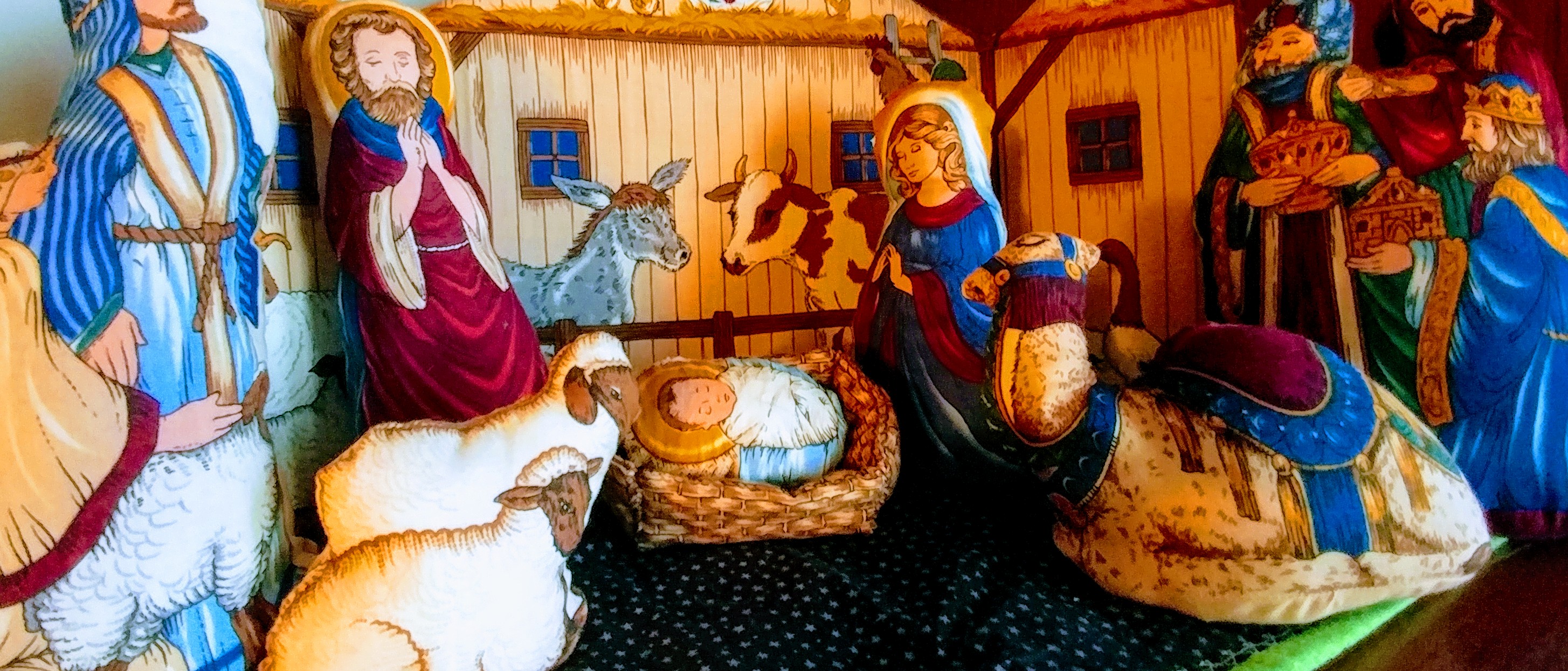
Last week, my husband hurled our Christmas tree out of our living room window. We discovered this method of getting the tree outside last year and it saves us from having to collect needles that were, in previous years, strewn across our living room to the front door. Pushing a tree out the window is also just ridiculous enough to feel liberating. While our tree (which was so dry that it was ready to go up in a fiery blaze) had to be disposed of early this year, our Nativity set reminds us that it is still Christmas for one more day. However, it is a different Nativity scene that I find myself contemplating as I write this.

Unlike the peaceful statues that depict the birth of Christ in my home, the Vatican Nativity scene this year has caused quite a bit of controversy. If you haven’t seen pictures of it, I would encourage you to look it up. Far from the usual tranquil and picturesque scenes that tend to depict Jesus’s birth, this one is chaotic and messy. The walls behind the Holy family appear to be crumbling. The figures are crowded together, so much so that it is sometimes hard to tell which appendage belongs to which statue. When we really think about the Christmas story, we realize that this is how it should be – Christ’s birth was chaotic and messy. His family was “living out of a suitcase” as they stayed in a town that was overflowing with visitors. They were sleeping in a shelter for animals which, no doubt meant that they were enjoying all of the sounds and smells that accompany a quaint barnyard birth. Into this environment that was far from homey, came unfamiliar visitors from diverse social classes. To top it all off, the king already wanted Jesus dead. Certainly there was peace and joy on that night, but that had nothing to do with Jesus’s surroundings. Instead, God Himself reached down and drew peace and joy out of a virgin womb. It was this act of God that brought those two gifts into the hearts of those who worshiped the newborn King who was born to dwell in the desperation, filth and despair of humanity.

While the infant Jesus is at the center of the Vatican’s Nativity scene, the figures that surround the more traditional Christmas statues reveal another aspect of our Savior through the corporal works of mercy that they are performing. In one corner, a woman quenches her neighbors thirst. In another, a man offers dignity to a boy lying naked beneath him by offering him clothes. At the bottom of the scene, with arms outstretched, a figure walks toward an invalid who is bandaged and flushed with fever. Next to them, someone visits a prisoner and, in the far corner, a young man provides burial for a dead body. These figures not only prod us to do what Jesus calls us to do, but they remind us that the irresistible baby lying in a manger would grow up to be a man whose teachings divided families, who demanded that we take up our cross daily, and who told us that to truly serve Him, we must care for others.

 “Then the King will say to those on his right, ‘Come, you who are blessed by my Father; take your inheritance, the kingdom prepared for you since the creation of the world. For I was hungry and you gave me something to eat, I was thirsty and you gave me something to drink, I was a stranger and you invited me in, I needed clothes and you clothed me, I was sick and you looked after me, I was in prison and you came to visit me.’

“Then the righteous will answer him, ‘Lord, when did we see you hungry and feed you, or thirsty and give you something to drink? When did we see you a stranger and invite you in, or needing clothes and clothe you? When did we see you sick or in prison and go to visit you?

“The King will reply, ‘Truly I tell you, whatever you did for one of the least of these brothers and sisters of mine, you did for me.’” Matthew 25:34-40

If you know this passage, you will also know that Jesus’s next words are some of the most terrifying in the Bible:

Depart from me, you who are cursed, into the eternal fire prepared for the devil and his angels. For I was hungry and you gave me nothing to eat, I was thirsty and you gave me nothing to drink, I was a stranger and you did not invite me in, I needed clothes and you did not clothe me, I was sick and in prison and you did not look after me.’” Matthew 25:41-43

Every time I read these words, I shudder. For how much food do I have in my pantry, while there is still great hunger in the world? How easily do I open my faucet that flows with pure water, while children are dying from diseases borne by unclean water? How many strangers have I failed to welcome into the safe, little world that I exist in? How many homeless men and women are shivering on the streets, while hats, gloves, scarves and coats hang unused in my closets? How many times have I been too busy or afraid to offer help to the sick or to those who are cast aside or imprisoned by society? The reality is that I do not measure up well to the standard that Jesus has set before me. However, one of the incredible mysteries of our faith is that salvation is available only through Christ even though we do not deserve it and, yet, Jesus Himself has commanded us to perform great acts of love and sacrifice.

The 2017 Vatican Nativity, portrays both of these truths: that God loved the world so much that He sent His son to be born amidst a desperate people and that He sends us to minister to that world today. It reminds us that faith in Christ has little to do with adoring the little Lord Jesus who made no crying and much more to do with following a man whose message was loud and painful. It forces us to consider the reality that, from birth, our God made His home in the often dirty, fragrant, and chaotic company of the poor, the forgotten, the sinners, the hopeless. It makes us wonder whether or not we have made our homes with Him there, too.