Another Way: Growing Into A Pro-Whole-Life Ethic

Featured on Where Peter Is on April 27, 2022

Content Warning: This article includes personal stories of miscarriage and infant loss as well as discussions of abortion which may be difficult for some readers. 


I was a child the first time I heard the Christian band 2nd Chapter of Acts sing, “My God, they’re killing thousands. Killing thousands, without blinking an eye.” I still remember my horror when my mother explained what the lyrics referred to: that sometimes people kill babies before they are even born.

That was my introduction to abortion. As I grew, my lessons continued. Raised an evangelical Christian, I could have been the poster child for the pro-life movement. I helped gather items for baby showers at the pregnancy care center and I organized pro-life walks at my public high school. I engaged in lengthy debates with a close family member, whose nursing career had shown her the horrors of pre-Roe v. Wade botched abortions. In my spare time, I read books about abortion survivors and mothers who chose to fight for their sick infants’ lives at great cost to their own. My carefully crafted homeschool sexual education curriculum even involved a meeting with the director of our local pregnancy care center.

When, as a young adult I became Catholic, many would have assumed that I might become even more immersed in the pro-life movement. However, while the reality of abortion continued to upset me, I found myself becoming uneasy about some of the tactics that the pro-life community was using to fight the battle against it. At first, my concerns were theoretical. I reasoned that confronting a pregnant mother as she entered an abortion clinic was probably not terribly effective. Living in the city, I had plenty of opportunities to see how universally avoided and ignored any unsolicited “street preaching” was, and I began to suspect that protests at abortion clinics were met with similar responses. 

Later, my doubts became more personal. I began to see friends who had previously been open to Christianity turn away from it because of the often loveless presentation of pro-life arguments. I heard people who I care deeply about tell me that they could not believe in Christianity because of the hypocrisy they perceived in people who were pro-life. They were scandalized by Christians who professed to value an unborn baby but simultaneously devalued so many other lives (immigrant lives, Black lives, prisoners’ lives, and the lives of those living in poverty, for example). I watched as Catholics walked away from the Christian faith and I began to grieve as people I loved moved further and further from Christ, pushed away by zealous people who were so focused on the lives of the unborn that they had forgotten the precious souls of the born. 

While I was experiencing this growing unease about the pro-life movement’s methods, I lost one daughter at birth and another at 10 weeks gestation. Later, I found myself journeying alongside other bereaved parents, some of whom had made the heart-wrenching decision to terminate a medically compromised pregnancy that they had eagerly anticipated because they wanted to spare their child from future suffering. A common theme for these parents was their fear that even their closest family members would judge their decision harshly and without listening. As a result, many of them had never spoken openly of their losses prior to joining a confidential support group. Instead, they were grieving alone – sometimes for years. 

I sat with these parents who were desperately grieving the loss of their babies and remembered my own daughters’ vastly different deaths. I reflected on the times that I have worried that the first one, Noemi, suffered as she died. When we met to discuss her autopsy results with my doctor, I desperately asked him, “How long did it take for Noemi to lose consciousness without oxygen?” I needed him to say it took seconds, but he could not honestly give me the answer I sought. Instead, he quietly said, “Because she had not started breathing on her own yet, I really don’t know.” My maternal heart broke all over again. For weeks, I lay awake at night wondering if my baby knew to panic when she could not breathe, even though she had never taken a breath before. Was the fear of suffocation learned or instinctual? I worried that she must have experienced terrible pain as her lungs became so eaten by bacteria that they broke apart and adhered together again in all the wrong places. I felt so guilty that she had suffered all alone under a bright light while the NICU team broke her tiny ribs and stuck tubes in her sides to release the air escaping from her ruptured lungs. I grieved that my husband and I were not with her as she died, since my own blood pressure began crashing shortly after she was delivered. 

In contrast, I remembered the peaceful death that my miscarried baby, Marianka, must have had because of her Turner Syndrome. I thought about her passing away silently in the warm embrace of my womb, never knowing cold or panic. I was comforted to know that her little misshapen body never knew the pain of destruction; it simply could not function and grow in the way that it had been knitted together. I agreed with my doctor when she said, “It is a blessing it happened so early because usually it happens later with Turner Syndrome.” I smiled to think that Marianka was never alone–not for a moment. She went straight from safely inside her mother into the arms of God.

With these memories of my worries about my children’s suffering crowding my mind, I find I cannot blame parents who try to give their sick babies a quicker and more peaceful death, even if abortion may not actually provide such a death. Some of these parents face diagnoses that will make their child’s life extremely difficult, if not impossible. Others experience pregnancy complications that put their life or the life of their unborn child in grave danger. Often, doctors recommend the termination of their pregnancies as the only real option for them. When I consider what it must be like to find myself in such a situation, I realize that if I did not believe that God alone holds our lives in His hands, then I suspect that I too would choose to end my child’s life before he or she suffers. If I did not believe that God would redeem even our most terrible suffering, then I would give anything to limit my child’s pain. I understand these parents; I share their grief from losing a child. I am angry that Christians, who should be walking with these parents through their terrible suffering, are magnifying it by alienating and vilifying them as “murderers.”

For a long time, these experiences caused me to hesitate when someone asked me if I was pro-life. Even now, my convictions and my reflections on both my early experiences and my maternal ones still  make this a challenging question to answer. Instead of answering with a simple “yes” or “no,” I have begun to respond that I am “pro-whole-life.” By providing us with a “consistent ethic of life,” I believe that the whole-life approach offers a way out of the gridlock of pro-life versus pro-choice and towards a more meaningful dialogue that can protect the lives of the unborn while simultaneously caring for God’s precious children who have already been born.  

In the next installment of this series, I will explore some practical suggestions, rooted in our Catholic faith, for how we can offer support to families who have faced abortion decisions due to prenatal diagnosis.
Lessons from the Vatican Nativity Scenes

Featured on Where Peter Is on January 4, 2022

Of all the decorations that we put out for Christmas, my favorite are my Nativity scenes. Over the years, I have collected many different portrayals of Christ’s birth – from paper cut-outs to nesting dolls – and each offers a different insight into Jesus’s arrival. While most of our scenes are completed on Christmas morning when the Jesus figures are placed in the mangers, our family’s main Nativity is finished right before we take it down on Epiphany. Our Wise Men arrive at the stable after making a journey through our house during Advent and Christmas. With two young children, their journey is almost as perilous as that of the real Magi, and I am always reminded of the real-life challenges that faced each of the people involved in the first Christmas story.

The beauty of Nativity scenes is that they offer us little visual oases amid our festive holiday chaos. When we choose to allow our eyes to rest on them and our minds to embrace them, they draw us towards the reason for our Christmas celebrations and help us to consider Christ’s birth in new and tangible ways. It is for this reason that Pope Francis has noted the importance of these “simple and wonderful” reminders of our faith. In 2019, he wrote that Nativity scenes are “a genuine way of communicating the Gospel, in a world that sometimes seems to be afraid to remember what Christmas really is, and erases the Christian signs, keeping only trivial and commercial images.” Pope Francis invites us to “pause before the nativity scene, because the tenderness of God speaks to us there. There we contemplate divine mercy, which became human flesh and is able to soften our gaze.” Considering the role that Pope Francis sees Nativity scenes playing in our faith, it is not surprising that, each year, the Vatican carefully selects one to display on St. Peter’s Square. Throughout Pope Francis’s Papacy, these yearly displays have served to highlight lessons that are near to his heart.

By Christmas of 2013, Pope Francis’s first Christmas as Pope, his teachings were already subtly influencing the Nativity scene on display in St. Peter’s square. Titled Francis 1223-2013the scene was meant to remind the faithful of the saint who is credited with first using a Nativity scene to teach the Christian faith and whose name Pope Francis chose as his own: St. Francis of Assisi. Consequently, while that year’s Nativity scene was in many ways a traditional one from Naples, it included an emphasis on the humility of Christ who came to humble and ordinary people. Intermixed with the richly robed traditional figures were peasants dressed in poorer attire. A beggar even knelt before the foot of the Christ Child as a clear reminder that Jesus came for all of us and that He has a heart for the poor and the destitute, just like our current Pope and his namesake.

The Vatican Nativity of 2014 was donated by Verona and staged like an opera. This dramatic setting was meant to remind us that Jesus is God’s masterpiece given to the world. Yet even in this elaborate scene, which differs from the simplicity that Pope Francis often embraces, the youthful faces of Jesus’s parents remind viewers that God’s majesty came to very real, vulnerable people here on earth. Far from a masterpiece meant only for the world’s elite, Jesus was God’s opus for all people.

This idea of Christ coming humbly for each one of us was emphasized in the life-size nativity of 2015. The openness of the scene and the lifelike characteristics of its figures made viewers feel like they could walk into it and begin conversing with the shepherds or fall down in worship before the Christ Child that lay in the middle of a simple, everyday barn scene. In Pope Francis’s address thanking the people of Trento for the Nativity that year, he said that the scene reminds us that Christ “did not change history by performing an elaborate miracle. He came instead with total simplicity, humility, and meekness. God does not like grandiose revolutions of history’s powerful, and he does not use a magic wand to change situations. Instead, he makes himself small, he becomes a child, so as to attract us with love, to touch our hearts with his humble goodness; to unsettle, with his poverty, those who scramble to accumulate the false treasures of this world.”

In 2016, the Vatican Nativity took this message of Christ coming for all of us and sought to help those who saw it to apply it to their lives and actions. In the midst of growing nationalism throughout the world and the migrant crisis in Europe, the Nativity scene included a boat that Pope Francis said was a reminder of migrants who have died while journeying from Africa to Europe. He said, “The painful experience of these brothers and sisters reminds us of that baby Jesus, who could not find shelter, was born in a stable in Bethlehem and was later brought to Egypt to escape Herod’s threat.” One reporter noted that the message of love portrayed in this Nativity scene was emphasized by the homeless men and women who sat around St. Peter’s square waiting for a free hot shower or haircut through Pope Francis’ programs for the homeless.

Love for the least of these was central to the 2017 Nativity, which ensured that the point was truly driven home. My personal favorite of all the Nativity displays during Pope Francis’s papacy, this scene created quite a bit of controversy among people who felt that the message was too intense for Christmas. While the infant Jesus was at the center of the scene, the figures that surrounded the more traditional Christmas statues revealed another aspect of our Savior through the corporal works of mercy that they were performing. In one corner, a woman quenched her neighbor’s thirst. In another, a man offered clothes to a naked boy. At the bottom of the scene, with arms outstretched, a figure walked toward an invalid who was bandaged and flushed with fever. Next to them, someone visited a prisoner and, in a far corner, a young man provided burial for a dead body. The actions of these untraditional figures not only prodded viewers to do what Jesus called them to do, but they reminded them that the irresistible baby lying in a manger would grow up to be a man whose teachings demanded that we take up our cross daily, and who taught us that to truly serve Him, we must care for others. In many ways, the 2017 Vatican Nativity scene was a culmination of the teachings from the earlier Nativity scenes of Pope Francis’s Papacy.

Perhaps because of the clear message given in 2017, the Vatican Nativity Scene of 2018 shifted away from the social teachings that Pope Francis emphasizes and recentered on the nature of Jesus himself. The scene that year was carved from sand, which, like the temporal life on earth that Jesus embraced, lasts only a little while and then is gone. The nature of the sand reminded viewers both of Christ’s amazing victory in overcoming death and of the temporariness of life without Christ. Characteristically focused on Jesus’s willingness to sacrifice and to become one with humble humanity, Pope Francis said of the sand that it, “a poor material, recalls the simplicity, the smallness with which God reveals himself with the birth of Jesus and the precariousness of Bethlehem.”

In 2019, the Vatican Nativity scene drove home our need for such a generous Savior who joins us in our own precarious existence. Donated by people in the Northern Province of Trento, the scene included figures that were made to look like real people from the region, one of whom had recently died. The shepherds wore authentic clothes, some passed down through families and worn by real shepherds. The architecture also reflected the reality of the region where it was made, making it clear that the Christ Child came, not just to people long ago and in a far-off land, but to us here and now. While this is a powerful lesson, the wood from which the scene was made taught the greatest lesson: our need for this small child. The wood was taken from trees that had fallen during a severe storm that hit the region in 2019 and which was largely attributed to global warming. As a result, the image that the scene conveyed was literally that of our Savior being born into the midst of the environmental crisis that looms over us. In short, the Nativity scene showed that Christ’s birth brings the light of hope even into our darkest trials on this earth. That was a timely message for a world that was on the brink of plunging into a global Pandemic.

Amid the first dark pandemic winter surge, many looked to the 2020 Vatican Nativity for a similar message of hope and found it wanting. Unlike previous scenes, this one used modern art to portray Christ’s birth. The figures, which were made by students and teachers in the 1960s and 70s were donated from Castelli. Like large ceramic chess pieces, many viewers found them to be cold and strange while offering little comfort. However, for those who were willing to learn from that which unsettled them, the scene held important spiritual lessons. Some were overt, like the astronaut that was depicted as offering baby Jesus the moon or, in other words, offering him our scientific discoveries and humanity’s greatest accomplishments. In a year when scientists rushed to successfully create vaccines against Covid-19, this seemed particularly relevant and a reminder to give thanks for the gift God has given us through the medical community. Other lessons were more subtle. For example, the school where the figures were made during the last century was intended to “revive and modernize” what was once a thriving ceramic industry in the region of Castelli. Like Pope Francis’s book, Let Us Dream, the scene reminds us that, as the traditions and world around us change, we are faced with a choice: to dream about new ways of being in the world that will benefit all people or to cling to the old, failing ways of existing that have caused pain and suffering and will ultimately fail us. The scene challenges us to let Jesus break out of the boxes we often confine him in and to lead us to new and unexpected places, even when, like Abraham, we do not know where he is leading (Heb 11:8). It was, a message that the world desperately needed to hear, but fiercely resisted.

This year, the Vatican Nativity scene came from the Americas for the first time. Celebrating Peru’s 200th anniversary of independence, the scene depicts Christ’s birth in the setting of Chopca, Peru. The infant Jesus is dressed in the traditional clothes of a baby. The magi come bringing native gifts like quinoa, corn, and potatoes. Instead of donkeys and sheep, the scene is filled with llamas, alpacas and even an Andean Condor. Yet the people are the most captivating part of the scene. Their brightly colored clothing, musical instruments, and joy-filled faces bring a smile to even the most COVID-weary. As Bishop Salcedo of Peru stated, he is constantly learning from the people’s joy and hope, and this is reflected in the Nativity scene on display in St. Peter’s square this year. By choosing to display this Nativity, the Vatican has allowed the people of Peru to teach the world the same valuable lesson that they daily teach their Bishop: that “despite the difficulties, such as the pandemic as well as other ‘pandemics,’ like poverty, corruption or the neglect of government authorities,” it is still possible to find joy and hope in Christ’s birth. In a world that has been repeatedly beaten down by sickness, injustice, environmental destruction, and tribalism, the message of this year’s Vatican Nativity is much needed: Christ has come to all people of all nations and He comes bearing great love and deep joy.

The Other Side of the Good News

Note: I am working to consolidate all of my work into one location. This article and several that follow, were featured elsewhere and are not necessarily up-to-date with current information.

Featured on Where Peter Is December 20, 2021

“Most people are good,” I reassured my three-year-old son who was convinced that a stranger was about to harm me. Over the past few weeks, the toll that the pandemic has taken on his social-emotional development is becoming more apparent: since we taught him to keep away from people for most of his life, it was probably inevitable that he would start to fear them.

My statement was meant to soothe him and to begin to repair the damage that COVID-19 has wrought. However, even as it left my mouth, I began to wonder if I really believed it to be true. Certainly, I did not anticipate being injured by anyone that night, but considering everything that has happened recently in our world, our communities, and the Church, I wondered if I still believed that most people are good? So many of the people I once esteemed as models of faith – both lay and religious members of the Church – have done and supported things in the past few years that are totally opposite of what is good and right. If I hesitate to say that even those faith warriors are good, then who is? As I thought about this, I began to question if the belief in human goodness that I was imparting to my son aligns with what I believe as a Catholic. My journey through the penitential season of Advent and my reflections on my own sins also came into stark focus reminding me that I did not even consider myself to be good.

What we believe about the goodness of most people has a profound impact on the way we live and how we understand our relationship to God. When we believe that most people are not good, then we risk losing our motivation to be better. An example of such thinking appeared in an article about a July debate among members of the Ohio State Board of Education over a resolution to review its curriculum to ensure that racism and bias were adequately addressed. The resolution would also require Department of Education employees and contractors to receive implicit bias training. Board member Mike Toal commented on this training, which he had already received, saying, “I found it disturbing because I could never be that good. Being a Christian, I’ve learned over many, many years that none of us reach that level of purity.” Frankly, if people are bad and there is nothing we can do about it, then he is right to argue that such training is nothing more than disturbing because it simply reminds us of what cannot be. The same could be said of any number of efforts we make to improve ourselves and our world. This negative view of human nature leaves us in a helpless position spiritually as well. Without goodness, what is left for God to redeem?

On the other hand, the belief that people are good flies in the face of what we know about ourselves. As the Catechism of the Catholic Church correctly points out:

“What Revelation makes known to us is confirmed by our own experience. For when man looks into his own heart, he finds that he is drawn towards what is wrong and sunk in many evil ways from his good creator.” (CCC 401)

Of course, one must only glance at a few news articles to see that this is true. The idea that people are basically good leaves us vulnerable to many mistakes. The Catechism itself states that “ignorance of the fact that man has a wounded nature inclined to evil gives rise to serious errors in the areas of education, politics, social action, and morals” (CCC 407), and we see this borne out in our own world. Whenever we rely on the goodness of humanity, it invariably fails. The abuses of the trust placed in the goodness of Church leaders (as manifested in the sexual abuse scandals and mistreatment at Canadian residential schools for Indigenous children) are tragic examples of this within the Church. The refusal of many in the Church to comply with public health recommendations during the pandemic, even within our local parishes, is another.

Viewing humankind as simply good or bad is an incomplete understanding of human nature. It sets us up for errors in our thinking and way of life. However, the Church, in her wisdom, has offered us an alternative understanding of the state of humanity: the doctrine of original sin.

This doctrine begins with the creation story. The good God made people and since He is all good, His creation is also good. In a fundamental way, then, all people are good. However, through the sin of Adam and Eve, sin corrupted God’s creations. The Catechism is quick to point out that the way that this happens is a mystery, however, it describes our human condition after sin in this way:

“By yielding to the tempter, Adam and Eve committed a personal sin, but this sin affected the human nature that they would then transmit in a fallen state. It is a sin which will be transmitted by propagation to all mankind, that is by the transmission of a human nature deprived of original holiness and justice.” (CCC 404)

In other words, the goodness we all have by nature of our status as God’s creation is corrupted. Our Baptism cleanses us from our original sin, but “the consequences for nature, weakened and inclined to evil, persist” (CCC 405). As a result, even those of us who have been cleansed by the waters of Baptism are engaged in a spiritual battle of good and evil throughout our lives. Far from justifying us giving up and settling for our sinful state, it is our obligation as Christians to do everything we can to fight for the victory of good. Pope Francis’s challenging social teachings have made this clear throughout his papacy and I wonder if some of the resistance he has faced stems from a poor understanding of our fallen human nature.

The good news is that while the battle we face is fierce, we are not left to fight it alone. Instead, God Himself fights with us.

“The whole of man’s history has been the story of a dour combat with the powers of evil, stretching, so our Lord tells us, from the very dawn of history until the last day. Finding himself in the midst of the battlefield man has to struggle to do what is right, and it is at great cost to himself, and aided by God’s grace, that he succeeds in achieving his own inner integrity.” (CCC 409)

Ironically, it is by facing our own corrupted, fallen nature and our own daily battle with sin that we truly recognize our need for the Savior whose birth marks the end of this penitential season. For if I was wrong in what I told my son and our goodness has been corrupted, then what hope do we have? None save a Savior whose nature has not been similarly marred.

The glad tidings that the angels proclaimed on that first Christmas night were that the good Savior has come! As St Paul tells us: “So then, just as one trespass brought condemnation for all men, so also one act of righteousness brought justification and life for all men. For just as through the disobedience of one man the many were made sinners, so also through the obedience of the one man the many will be made righteous” (Rom 5:18-19). The Catechism reminds us, “The doctrine of original sin is, so to speak, the ‘reverse side’ of the Good News that Jesus is the Savior of all men, that all need salvation and that salvation is offered to all through Christ” (CCC 389). That is wonderful news to us who, facing a world that is often so far from good, feel deep within our souls the longing for a Savior and the knowledge that He is our only hope.

Special Announcement

As I move away from using Facebook as my primary means of keeping everyone updated on my writing, I will be transitioning to periodic newsletters via email. If you want to keep up to date about my writing, go ahead and sign up via the link below. I promise I will not spam you with excessively long or annoyingly frequent messages!

[mailerlite_form form_id=2]

Top Ten Garden Tips: Tip Three

Now that garden season is starting to wind down, I have some time again to share my tips! Today’s tip is Lazy is Best.

This tip specifically relates to fall and winter/early spring gardening and is dependent upon the gardener not being lazy during the growing season when weeds must be pulled and plants cut back when necessary. However, once the leaves start to fall, it is best to cozy up and enjoy your garden as is, rather than doing a lot of maintenance work.

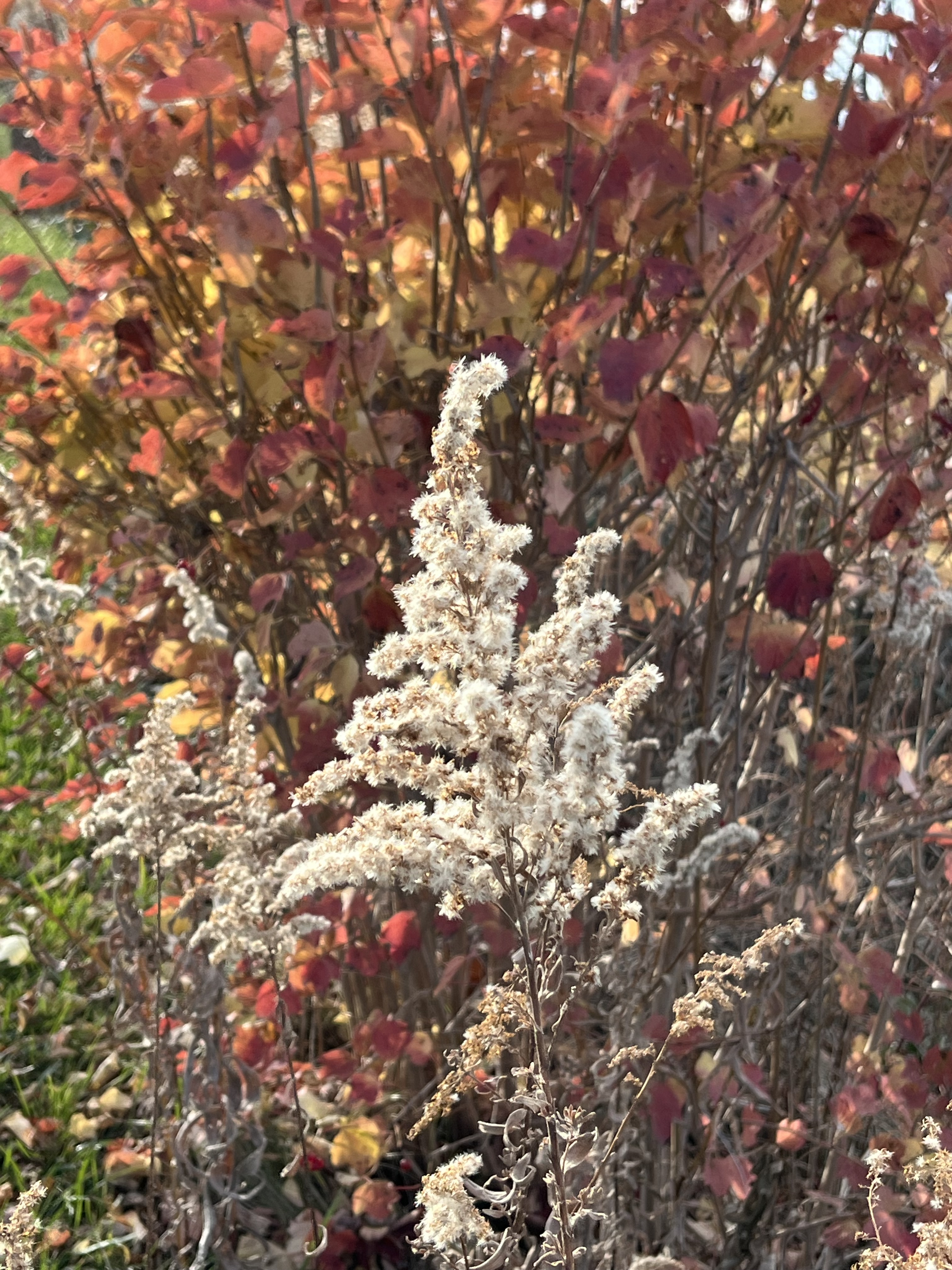
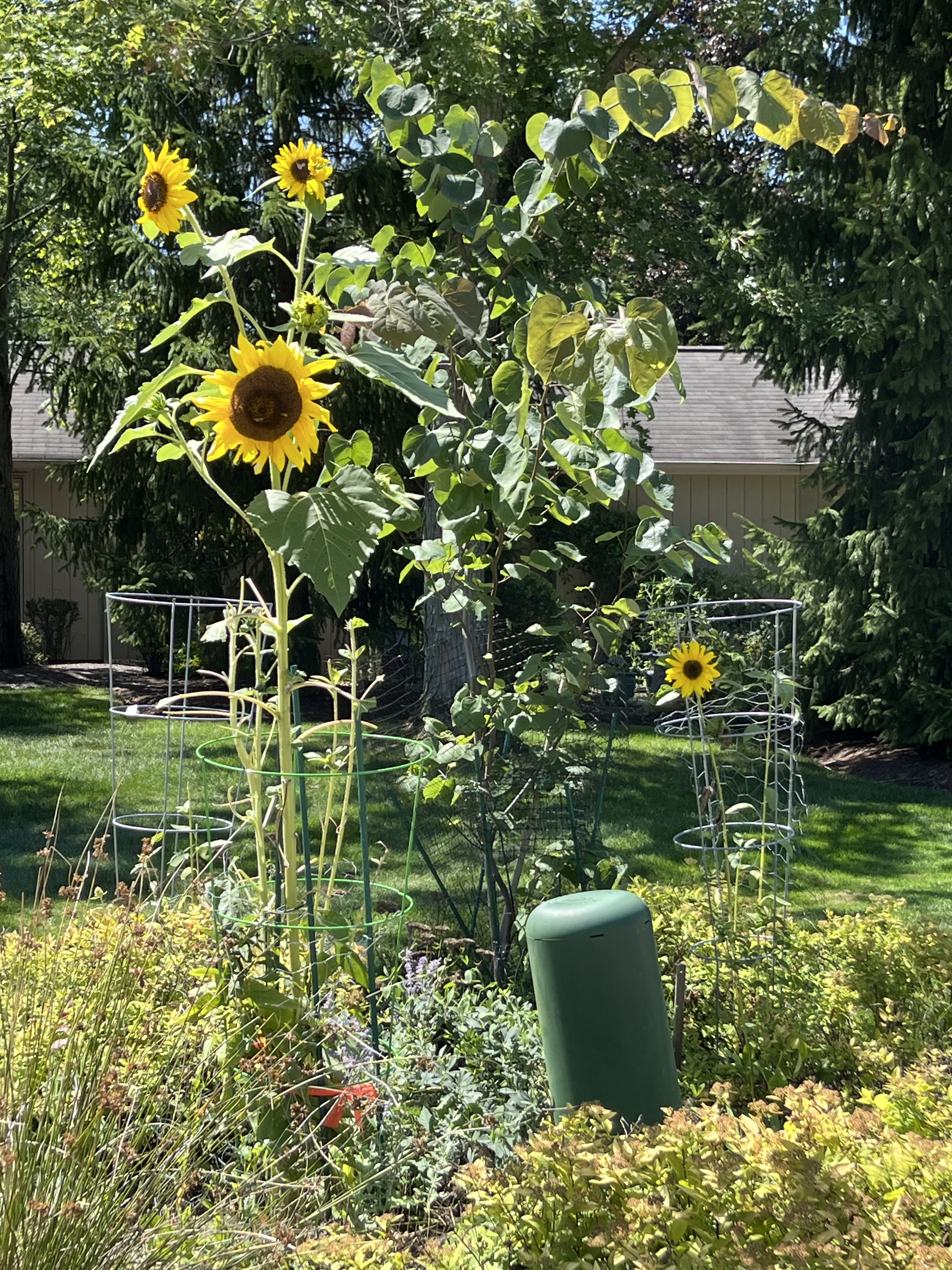
There are a few reasons for this. First, flowers that are allowed to go to seed provide natural nourishment to birds during the seasons when food is sparse. Last year, we left our sunflower standing throughout the winter and were thrilled to watch the birds slowly peck away at the seeds that lined its face.

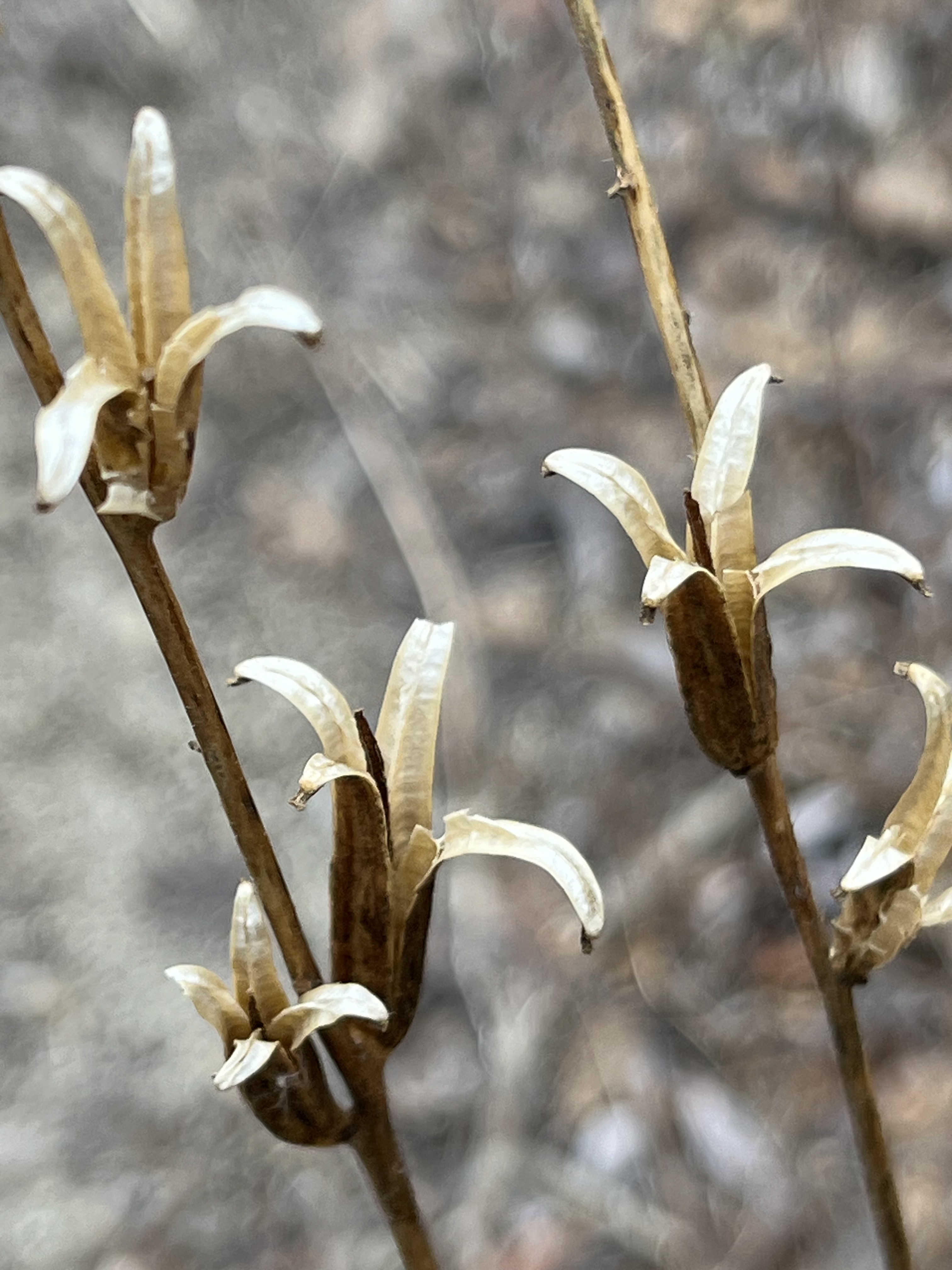
The second reason to leave your dying plants untouched is that standing stems provide shelter for insects and their eggs over the winter. This is why you may have seen posts telling you not to start gardening in the spring until it has reached a consistent fifty degrees. If you must chop down your dying plants, try to leave several inches of growth at the base, and lay the chopped stocks in a loose pile in a corner of your yard. This will provide some homes for insects and minimize your chances of disturbing those that have already taken up residence in your flowers.

Another reason that Lazy is Best is root protection. We have a bed of chrysanthemums that come back every year. Technically, the recommendation is to cover them with straw to keep them safe from our mid-West winters. However, I have found that when I leave the dead stocks standing until they are dry, I am able to cut them and let them fall in place to protect my roots. This saves me a lot of time and some money.

Letting the dead growth fall in place has other benefits. In the natural environment, nutrition is meant to cycle from the ground into the plants and then back into the earth when the plants die and decompose. Being lazy when it is not growing season allows this natural process to happen, making your soil more fertile for the next year. Just make sure that the decaying plant matter does not create too thick a barrier over your bed. Air needs to be able to get in and dry things out so that your roots don’t rot. Similarly, some plants will produce fertile seeds that can spread in your beds and help you fill in spaces between plants that would otherwise attract weeds. You may even be able to enjoy an annual plant two years in a row if it reseeds its self! Unfortunately, this will not always happen since many cultivated plants have sterile seeds, but most native plants and some others will spread via seed.

The last reason Lazy is Best is purely cosmetic. You have worked so hard all year to make your garden look interesting but if you chop down all of your growth in the fall, you miss out on its visual interest over the winter. Plants that are allowed to remain standing after they have died add different shapes, textures, and dimensions to your yard. They may also provide places for stunning icicles to form, snow to form natural sculptures, or Christmas lights to hang. Don’t turn your yard into a boring wasteland for the winter. Let it remain magical and intriguing.

So what should you be doing as part of your lazy autumn gardening? Here are some ideas to keep you busy:

  1. Mulch your fallen leaves and spread them over your beds. This saves a ton of money and provides your garden with valuable nutrients.
  2. Take in any lawn decorations that won’t withstand the winter.
  3. Dig up and bring in the bulbs of plants that can’t overwinter (my calla lilies are about to come into the dark garage where they will spend the colder months).
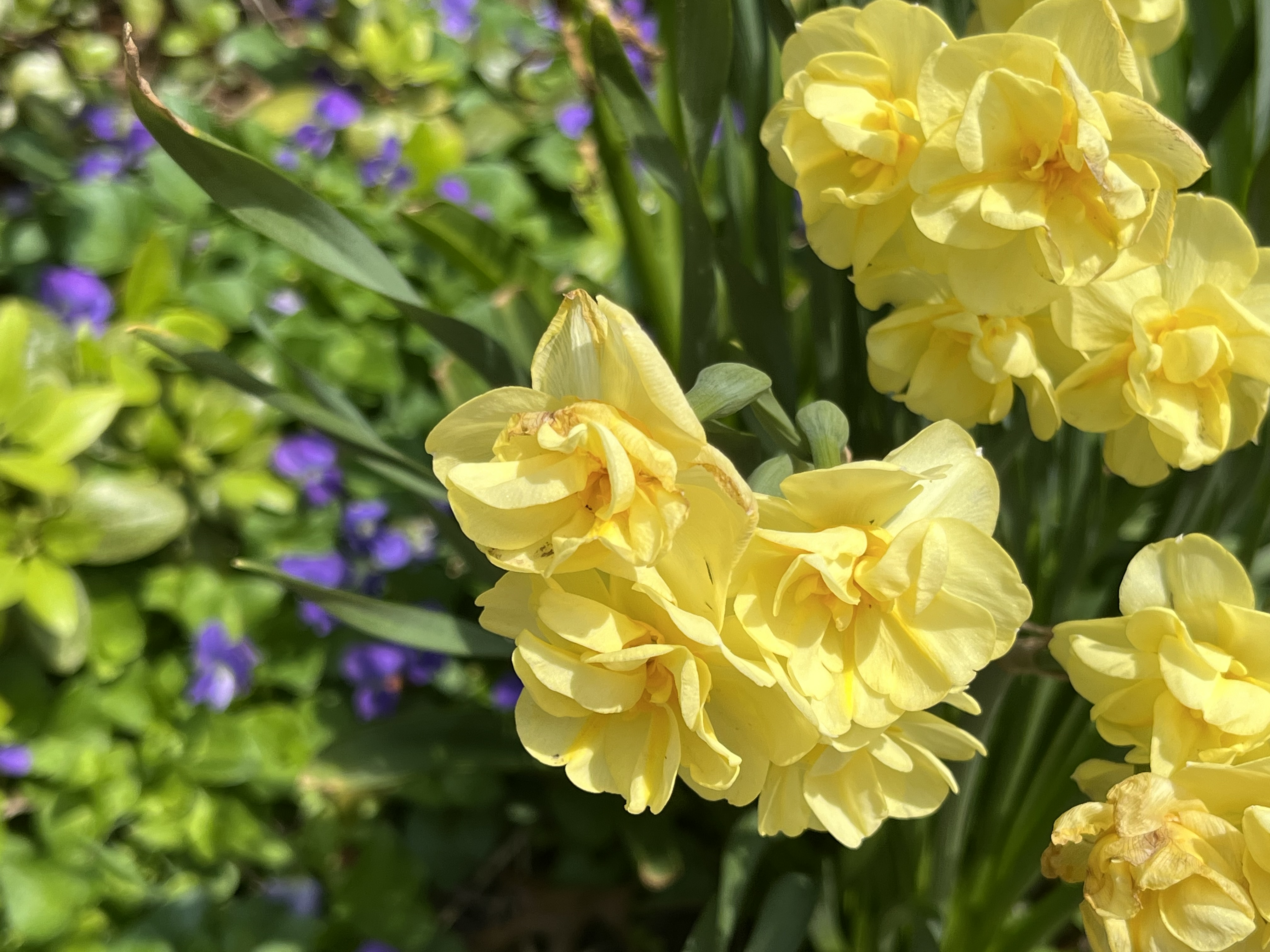
  4. Plant bulbs for spring flowers. Add a few each year for an eventual fairyland.
  5. Do any pruning for plants that require fall cutting.
  6. Cut back the bare minimum in your front yard to keep your HOA happy. Just make sure you pile the plant stocks loosely in an undisturbed corner of your yard.
  7. Make sure the birds have plenty of food and a water source that will not freeze over the winter (you can find heated bird baths that you just plug into your outdoor electrical outlet).

Have a happy, lazy fall!


Top Ten Garden Tips: Tip Two

Rain Gardens are incredibly practical and beautiful ways to deal with water issues in your yard while helping to preserve a healthy water supply and habitat for animal life.

A Rain Garden is basically a tub shaped garden into which rain water is redirected. The plants in a rain garden help to process water runoff back into the ground while purifying it of any pollutants it may have picked up. Species of plants are chosen and located based on the amount of water that is expected to pool in the bed when it rains and their location within the bed. In other words, water loving plants are placed in the center of the bed, with more dry-loving plants lining the sides. Native plants that can handle both flood and drought are often prioritized for all areas unless the ground is constantly wet.

The initial work of installing a rain garden is substantial, but not significantly more involved than installing any other garden bed. Once the garden is fully established, it is remarkably low maintenance and demands few resources. The plants are arranged so that, once they are fully grown, they take over the space in the garden. This eliminates opportunities for pesky weeds to grow. Additionally, because the garden bed self-waters during rains and the plants selected can tolerate drought, these gardens require very little extra watering, particularly if planted in the fall or early spring. This conserves water, limits water bills and saves gardeners time.

I began to work on my rain garden last fall when I recognized that the lawn was particularly dry and I did not want to be spending time and excessive money keeping it alive. However since the home is in the center of the town and beach activity, something needed to be done to enhance the curb appeal. In addition, since the house is right up the hill from one of the Great Lakes, I did not want pollution from our property running down the hill and into the lake. Finally, I did not like how close to the house our downspouts dumped, though this was necessary because of the narrow lot.

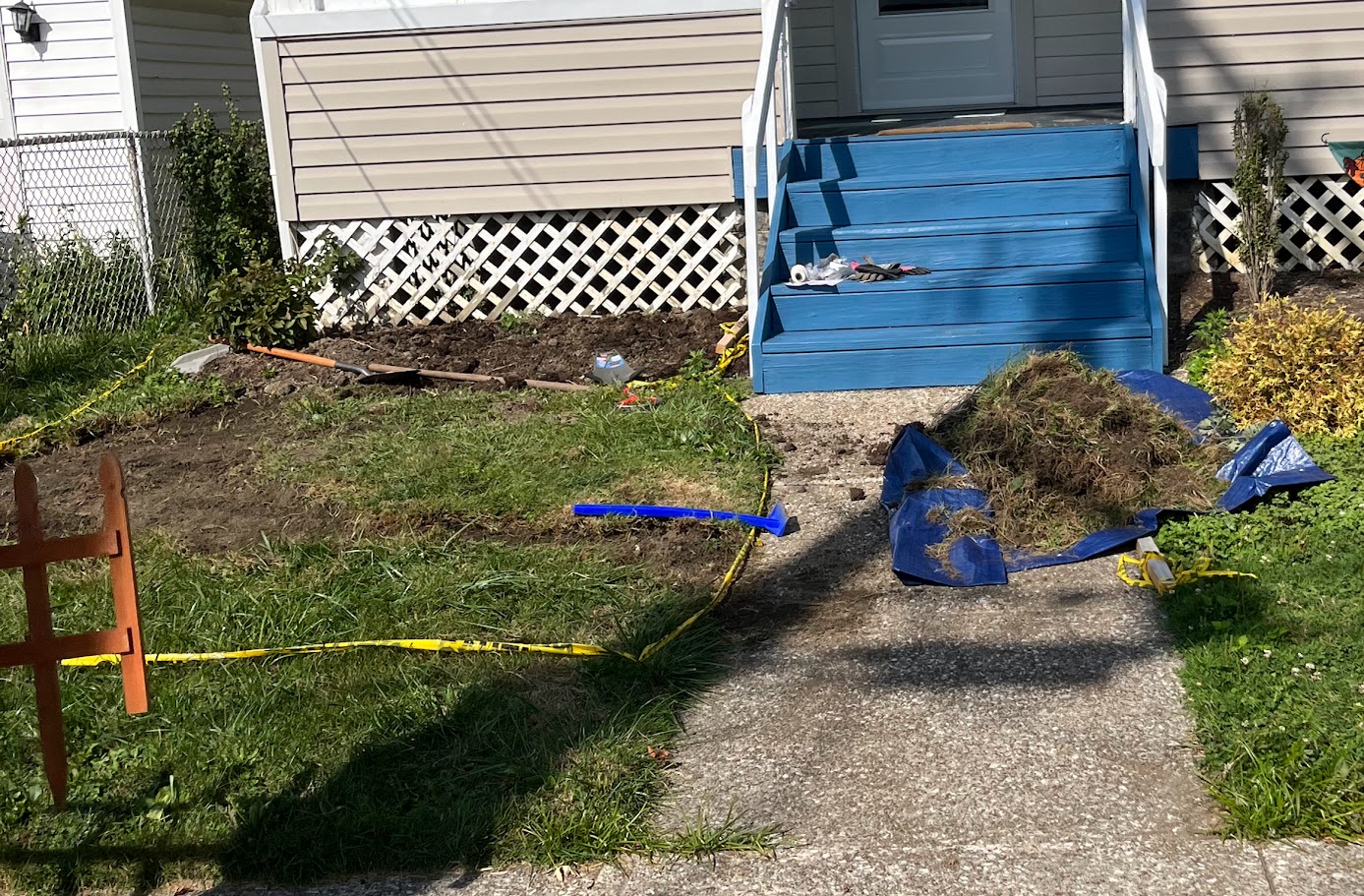
You can see the grass that I was concerned about in this picture. On the right, the grass nearly died in the summer heat. On the left, the lawn was doing better, but still quite dry, especially after a day of full sun.

I was unsure of whether I should put a rain garden on both sides of the walkway, or only on the left side, which had easy access to an additional downspout and would be able to filter the water from both our covered porch and half of our roof. The decision was made for me when I called 8-1-1 to find out what was underneath the lawn.

As you can see, the inspectors came out and found that our gas line runs almost through the middle of the right-hand yard. Since rain gardens require a significant amount of digging, placing one here was out of the question.

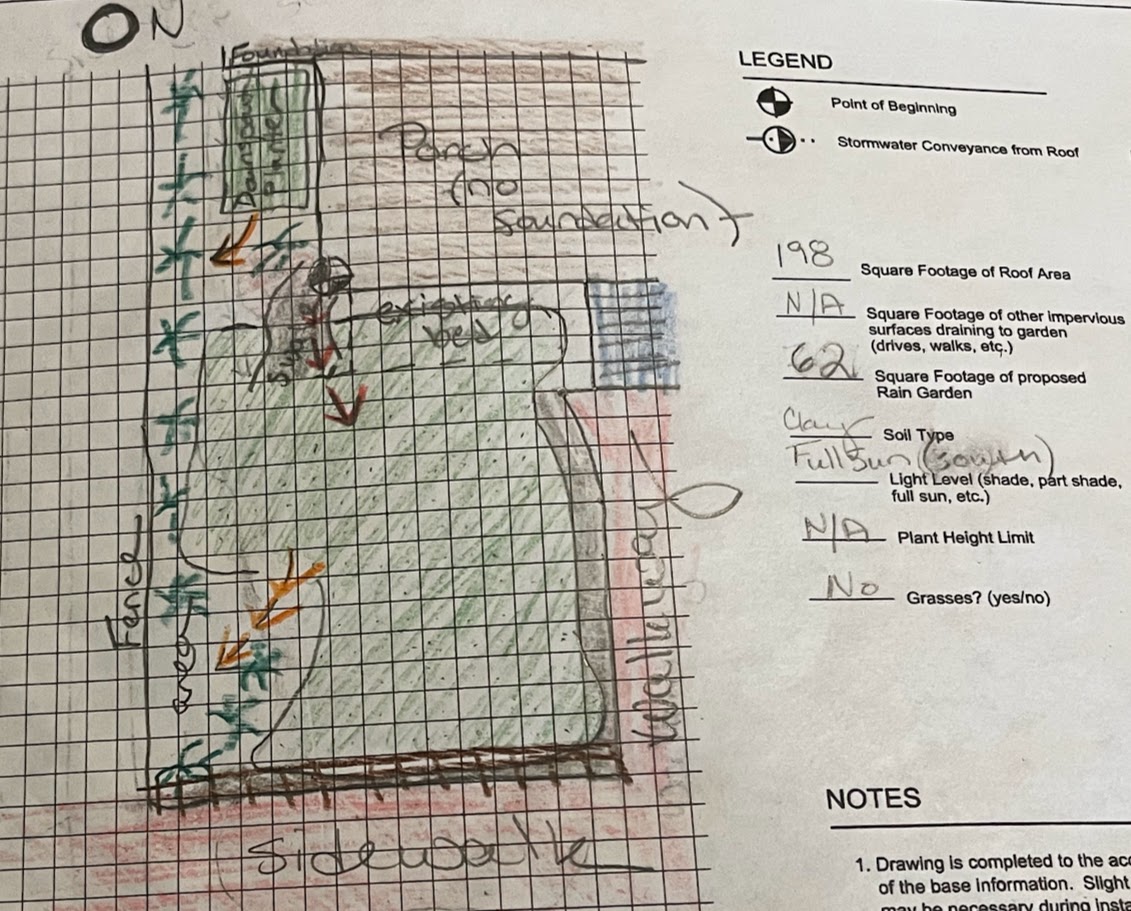
Once I had determined where to put the garden, it was time to start designing it! I used a piece of graph paper having each square to represent a square foot. I also cheated a bit and did some measurements of the garden and roof using google maps since we had not yet moved into the home. By planning it this way, I started out with a wealth of information: how much surface area would be draining into the bed, how much soil I would need, how much mulch to buy, and best of all, how many plants I would require.

Once I knew the surface area of both the garden and my drainage area (the roof) I needed one additional piece of information: how quickly did my soil drain? To find out, I had to do a percolation test. I dug a small hole in the middle of the where I intended to dig that went down about two feet. I filled the hole with water, waited for it to drain and then filled it again. Then I waited for the hole to empty. In my case, the hole did not drain within twenty-four hours so I knew that I needed to dig the garden bed to be three inches deep. I also knew that the garden needed to have an area that was at least 30% of the area of the drainage area. If it had drained within the twenty-four hour period, I would have needed to dig four to six inches deep and make the area of the garden 20% of the area of the drainage area. I am not sure why it works like this, but whoever came up with the calculations seems to have done a good job!

Due to space constraints (the garden had to be at least 10 feet from my yard and my property line), my bed was a little too small for the drainage area. However, the numbers were awfully close and, since the downspouts were basically just dropping water between the foundations of two homes, redirecting the water to the front yard would only help to solve the problem. If there was a risk of water running towards my foundation, the sidewalk, or the neighbors yard, I would have had to rethink my plans – one of a rain gardener’s goals is to “do no harm.”

Fortunately, I got the go ahead from my instructors and could recruit my kids for the garden’s installation!

We started in mid-fall. I began by laying down tape to let us know exactly where the garden should go. Then we began the exhausting task of removing the sod – but we didn’t throw it out – we saved it on a tarp for later. Once we had dug down the required three inches and made sure that the bed was completely flat in the center, it was time to start building up the berm that runs along the edges of the bed. The berm is important because it keeps the water in the pool area long enough that the plants can process it. The berm surrounds all of the sides of the garden except for a small gap where the water enters (this should be slightly elevated and flow down hill towards the garden) and the overflow area (this is about a foot wide lowering of the berm which will direct water in the right direction if the bed becomes too full). I lined the entry and overflow areas with gravel, then piled the sod we had removed from the garden along its edges to create the berm. My kids enjoyed running around to pack it down and by the spring, the grass had grown in to hold it all together.

Then it was time to add the soil back into the bed. We added four inches of topsoil followed by two inches of compost and then mixed it. This filled the bed with soil that was now loose and ready to hold water and plant roots. We topped the area with a layer of mulch so that we would not have to mulch around the plants and to help hold water in the soil. Finally, it was time to lay the plants out and see how they would look in the places I had planned for them! Once I was satisfied, we started digging and plopping those shoots into their spots.

Here you can see the newly planted garden. The stepping stones allow us to access the garden when it fills with water and is wet. In the far back corner you can see the gravel for the water inlet.

The garden did well over the winter and was surprisingly happy come spring. In fact, during the spring, it was only manually watered once and that was just because I was watering the newly installed bed on the other side of the yard and decided to do both. Basically, it has self-watered even with some dry 80 degree weather! There are a significant number of weeds this year since it has not yet filled in, but it will get easier each year. I expect that by year three it will be basically on autopilot.

The garden as it looks today, seven months after planting. It is really starting to grow after the winter pause and slowly filling in the empty spaces. This year it will still be laying down roots and establishing itself but by next year it should look like its always been there.

As you can see, a true rain garden takes a lot of work to set up and has some very specific site requirements that don’t always work. For example, in part of our yard, the ground was a mud pit in the spring, hard as rock in the summer, and full of roots all year round. The roots prevented me from installing a true rain garden in that spot, since the required digging would damage the trees. Regrading the area wasn’t an option since it would force water back into our foundation or onto our neighbors yard. However, by digging down slightly to redirect the majority of water into shallow basins that I lined with rock I was able to turn these dangerously tempting play areas into delightful and intentional looking garden spaces that boast plants that thrive in that environment.

The more formal bed which contains a statue and bird bath
along with the rock pool and plantings.
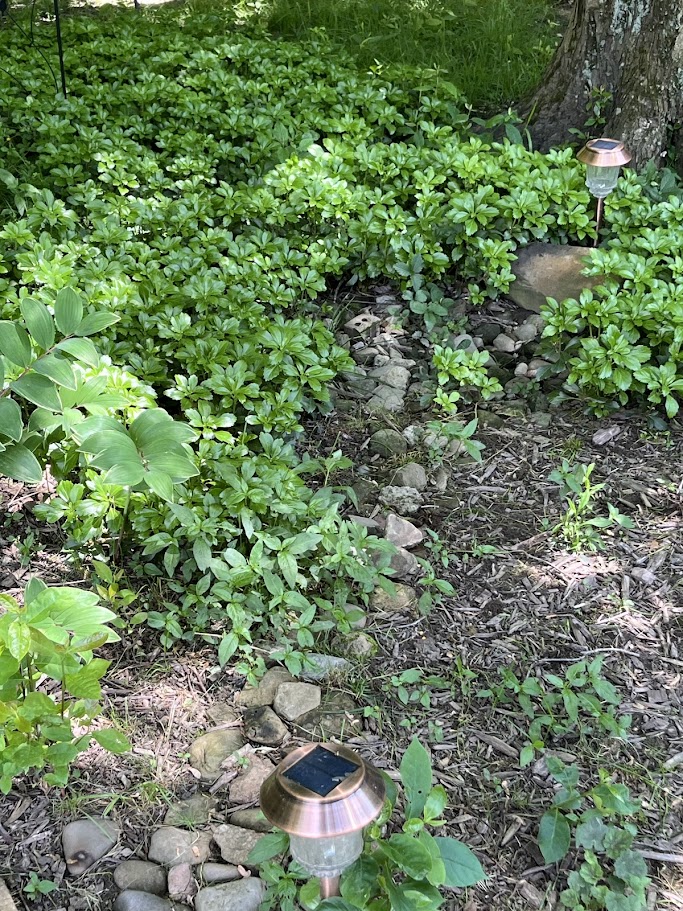
My more wild looking woodland bed and rock pond. The pachysandra is not native unfortunately, but was already there and when I drained the surrounding area slightly, it filled right in creating this peaceful setting!

So, if you aren’t looking to build a certified rain garden, there is no reason why you can’t use a less structured method to direct, pool and utilize water in problematic patches of your yard! It will likely require significantly less work and still offer you beautiful and practical landscaping options.

Top Ten Garden Tips: Tip One

I was strolling through my garden today taking pictures and I thought, why don’t I combine my favorite two solo activities (writing and gardening) and answer some of the questions my friends have been asking me lately? So when the heat of the noon sun drove me inside, that is exactly what I did!

I have to be honest, none of these ideas are things I came up with on my own. They are simply my favorite strategies that I have gleaned from a variety of classes, articles and in-person tips from fellow plantheads. Some of them are mainstream ideas, others not so much. My own yard has gone from a traditional suburban lawn and shrub garden (with some herbs thrown in) to a Certified Wildlife Habitat with an official (and some unofficial) Rain Gardens thrown in.

As much as possible, I try to be cognizant of the ways that my yardwork impacts native species around us and to use my yard to heal our earth. If my garden is blooming, buzzing with insect life, and filled with birds and other wildlife, then I consider myself to be successful. So in some ways, I am a green gardener. I use organic, plant based lawn care products (though my husband doesn’t always follow my lead), and we avoid invasive plants or plant them in places we know they cannot spread. However, I will say I am not hardcore enough to rip out (or refuse to buy) some beloved non-native plants as long as they don’t hurt our local ecosystem.

Also, in the garden, I believe less is more because less money and less labor means more time and resources to enjoy it! So if there are environmentally sound ways to reduce my costs and efforts, I am all for it.

Now that you know my overarching gardening philosophy, here is my first tip:

1. Green Mulching
When we first moved into our home, I spent days weeding each part of our garden. By the time I finished our yard, it was time to start weeding the first patch again. As I was breaking my back (literally) doing this, I also made the mistake of pulling out a lot of volunteer plants that I could have kept if I hadn’t been so narrow in my plant selection. As a result of my over-zealous weeding, we ended up with some major foundation water issues – all because I removed some plants during hours of laborious weeding!

The plants haven’t fully grown into this bed yet and you can still see some residual wood mulch under my leaf mulch. Still, considering that this patch took a day to weed in the past, Green Mulching has helped a lot.

Needless to say, the garden that I loved was quickly becoming my dreaded enemy and I couldn’t help feeling betrayed by the innocent looking rhododendrons staring at me through my front windows.

Then I discovered Green Mulching and, at the risk of sounding like a salesperson, it has been the best time saver/garden improvement I have found. The idea behind green mulching is to plant so many plants, so close together that there is no room left in your garden for the weeds to grow. This may sound chaotic but done properly, you can use layering (see a later tip) and ground cover plants to save literally days of your life (and years off of your back)! As an added bonus, telling people you are green mulching gives you an excuse to keep adding to your growing garden diversity and who among us does not need a reason to steer their car into the garden center parking lot?

This area took me hours to weed before I began green mulching and its right by my front door so I need it to look good! You can see a few tufts of grass that need to be pulled but that is all that I have to do now. In total, this section takes a minute or two to weed a few times a growing season.

As if those are not reasons enough to consider this method, Green Mulching is also more eco-friendly than more traditional mulching methods. Here’s why:

  1. Traditional Wood Mulches were originally not a terrible idea from an environmental standpoint. People have been mulching gardens for a long time using biodegradable materials like leaf matter and straw. In the last century, paper factories and other industries that utilized wood would sell off their wood waste to be used in garden beds. It eventually broke down and returned necessary nutrients to the garden soils that had been depleted by plant growth. In this setting, as long as no harmful chemicals were used to treat the wood, it was a great idea. However, once everyone started using mulch, the demand exceeded factory waste and wood mulch became an industry of its own. As a result, the mulch we buy at the store comes with real environmental (and financial) costs.
  2. Stone and Rubber Mulches, while longer lasting alternatives than wood mulch, have their own potential drawbacks. Most importantly, unlike wood and other types of biodegradable mulches, they don’t break down over time. As a result, the plant bed soil is depleted of nutrients overtime and these nutrients are not returned to it through the natural decomposition of dead plant matter. As a result, beds that use non-decaying mulches eventually lose some of their fertility and may require additional fertilizers and compost.

Green Mulching, on the other hand, allows gardeners to work with natural plant cycles while growing plants that benefit the environment. Following the natural pattern eliminates the unnecessary work that goes along with fighting nature. This is particularly true for planters who choose to leave plant matter standing over winter, compost dead plants, and mulch with leaves in the fall. Green Mulched beds are continuously refreshed with nutrients from previous plants. In addition, the dense leaf cover provides shade and holds moisture in the soil, limiting the amount of watering required, and the roots of plants help keep soil from eroding or compacting. And, of course, you save time by crowding out the weeds!

Treasure in Jars of Clay

I have walked down the aisle so many times before: as a baby in a baptismal gown; as a candidate wearing a dress that was specially selected for the final step of my journey into Catholicism; as a bride, veiled and adorned with white lace; as a mother carrying a little child draped in white. Yesterday, I came to the front of the Church shepherding a little girl whose post-Lacrosse hair had been forgotten and hung in an off-center, half-fallen out ponytail. I came carrying a little boy whose shoes were inadvertently left at home. I came after sitting through the reading of Christ’s Passion while trying to prevent that little boy from poking the lady in front of us with his palms. I came after whispering threats of spending the remainder of the service in his car seat if he didn’t quiet down and stop kicking the pew. I came hoping that no one heard him belting out, “The Doggy of Faith!” in a distorted echo of the priest. I came after keeping my foot suspended for almost an hour so that the kneeler did not get knocked down into any unsuspecting shins. I came after trying but failing to silently mouth instructions to my daughter through my mask. I came realizing I should have worn a belt with my new pants. I came thinking that I should have checked what my daughter picked to wear before we left for church. I came hobbling along with my ankle in a brace, unsure when it would choose to give out again. In short, I came as a very human, very imperfect person and that act of coming helped me realize the incredible beauty of my Savior and the Mass He gave us.

The wonder of our liturgy is not the bells that brought a gasp of awe from my distracted son and redirected his attention towards the altar. It is not the music we sing, texts we read, or words of prayer we say. It is not the faithful solemnly processing in a line. It is not those who are meticulously clad in their Sunday best. It is certainly not my ragamuffin family tripping and stumbling its way along.

The treasure of our liturgy is Jesus, himself. He is the one at whose presence the bells ring. It is Jesus to which all of our songs, readings and prayers point. He is the Bridegroom waiting for us at the aisle’s end with nothing but infinite love. He is the one who wants to be united to us whether we are dressed like royalty or paupers, knowing that we are all hopelessly a mess underneath the coverings with which we wrap ourselves. His unquenchable love for us that endures all of our short comings and His all-knowing and complete welcome are the true treasures of the Church. He is what makes our faith beautiful and in the process of surrendering our pride and coming to Him in the midst of our own humanness, we are made beautiful, too.

So I encourage you to come to Him this Holy week. Come with whatever shortcomings, embarassments, and disappointments you have. Come with your Lenten failures and your unruly children. Come if you don’t remember when to sit, stand or kneel. Come if it has been years since you last came. Come if you just can not get over your sense of guilt and shame. Come if you are late. Come however you can. You will find a Savior waiting for you with wide-open arms, ready to dazzle you with His unbelievable love as He welcomes you home.

Seeing the Perfect Christ In His Marred Body

When I was in high school, I spent a horrible week doubting that God is the good God who He says He is. Like far too many in our world, a family I cared about had been wounded by the abuse of someone who should have been safe for them and I could not understand how a good God would allow such a terrible thing to happen. I was angry and felt betrayed by the God who I had, up to that point, always trusted implicitly. Believe me, I let Him know about it. I raged at Him exactly as you might expect a rebelious teenager to do and, somehow, He responded by leading me to the Book of Job.

I devoured the chapters, accusing God alongside Job and then, suddenly, God spoke back. Who was I to question Him? Would I discredit His justice? Did I understand enough to condemn Him? Me, who was not there when the foundations of the earth were laid, who cannot command the sun and the moon, who has never walked in the heavenly storehouses full of snow? Like Job, my doubts were consumed in the wake of His overwhelming, mind-blowing presence. At the same time, my certainty that I knew enough to challenge Him was swallowed in the doubt that comes with the awareness of how little I truly knew. Who was this God I had challenged, this One whose power was so far above and simultaneously so encompassing of all the ways of man? Who was this Almighty Strength who could destroy me with a glance and yet chose to mercifully forgive my accusations and draw me more intimately to Him through my doubts? Could a God who has so many responses at His disposal but chooses to respond with gentleness be anything but good?

For the first time, the realization that God was so far beyond anything that I had ever thought or known engulfed me. I had always rested in the fatherly intimacy of God, yet, in that moment, I came face-to-face with His otherness.

It was this separation between God and His creation that helped me to make sense of how a good God was not irreconcilable with the evil committed by His people. Over the years, I have often come back to that lesson that God taught me during that torturous week of my adolescence – when facing abuse by a person studying to be a youth minister, when journeying into the Catholic Church with eyes wide open to the abuse that was covered up in the city of my birth, when wrestling with allegations within my own Catholic Community. Always, I am reminded that God and His Truth exist regardless of the actions of His creations and even His followers.

Yet, more recently, this has been harder to remember. Over the past few years, it seems that too many Christians have done unimaginably heinous things to mar the precious Body of Christ here on earth. From supporting ideology and lies that foment hate, to failing to sacrificially love and protect one another; from devaluing the precious value of all of the lives God has created, to allowing divisions to shatter Christian unity; from the unbelievably horrific acts in Canada’s Native American Schools, to the 330,000 child victims of abuse by the French Catholic Church; from my own Diocese’ choices that continue to lead to unnecessary COVID spread and deaths, endangering my own children, to the desires of some radical traditionalists for the Pope’s death – the actions of Christ’s representatives on earth recently have been heartbreaking.

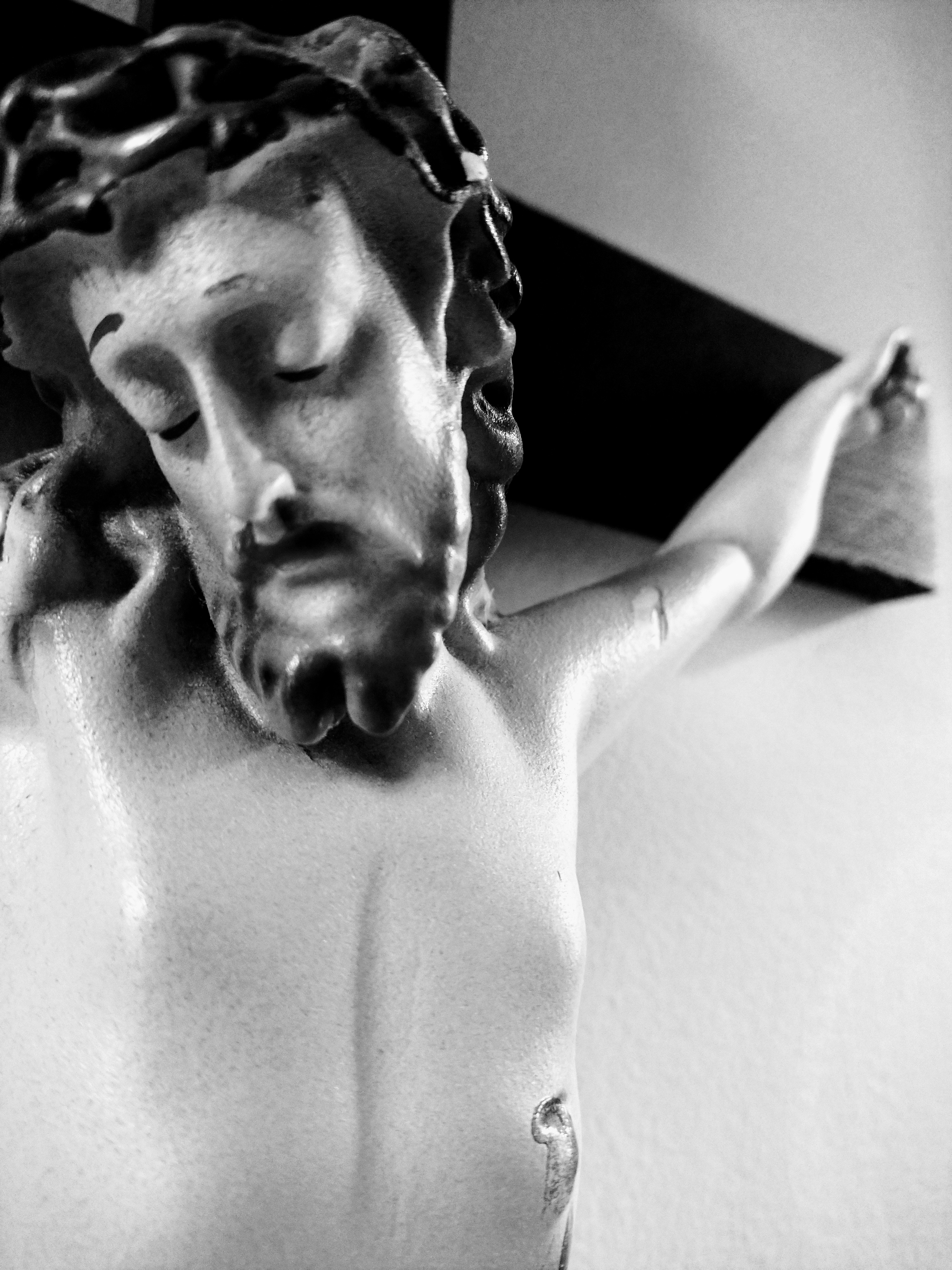
Yet, I can’t help but think of Christ’s other body and how man similarly marred and distorted it beyond recognition. I think of the image left on St. Veronica’s cloth – bruised, beaten, bleeding. I think of the broken back and the pierced hands. I think of the lifeless body, brought down from the cross and laid in the arms of a mother who knows she holds her Son but would not recognize Him if she had not stayed with Him throughout His destruction. I think of a powerless corpse, laid in a tomb and left to succumb to the final destruction of death’s decomposition.

And then…

And then that body had the power to do what none had ever done before. It defied death, defeated it, and it walked out of the grave.

Somehow, God took all of that damage and destruction of His son’s appearance and He made it the ultimate picture of Who He really is: a God of infinite love, mercy, and even power. Somehow, out of the distortion that His creation had inflicted on His image, He drew the purest, truest representation of Himself. He who described Himself simply as the One Who Is, was so far above and beyond the deeds of his creatures that what they did could in no way diminish Him. Infact, inspite of their worst intentions, their abuse only led to His glorification.

I don’t know how God will deal with the misrepresentations and distortions of His image here on earth right now, but I know that they won’t be the end of the story because I believe that God exists independently of anything His people do or don’t do. His goodness and His truth are not dependent upon us – they are realities that exist by their own right. He is, He has always been, and He will always be. Nothing we do can change that – it can only serve to glorify Him, whether or not that is our intention.

While We Were Sinners


The George Floyd trial and its reflection of the immense disregard for the sanctity of life that has come to the surface this past year has been weighing on me the past few days. The idea that someone’s race, social standing or age – things that they have no control over – could impact the value placed upon their life is abhorrent. We have seen this idea surface time and time again this past year and it has cost us so many lives and done huge damage to our souls. 
Yet, the idea that somehow someone’s drug use, or any other behavior, could make their life less valuable and their death more acceptable is equally opposite the teachings of true Christianity. Every religious observance we make this Good Friday should remind us of that. 

Paul wrote about what we remember today thus: “Very rarely will anyone die for a righteous man, though for a good man someone might possibly dare to die. But God proves His love for us in this: While we were still sinners, Christ died for us.” Paul then reminds us that Jesus died for us “while we were enemies of God.” Jesus came to us in the midst of our sin and while we were still sinners, He loved and valued us enough to give His own life so that we could have eternal life. If our Savior so valued us as sinners, who are we to say that anything anyone else does diminishes the value of their life?

Jonathan Edwards, a congregational minister from the 1700s said it this way: 

“Christ loved us, and was kind to us, and was willing to relieve us, though we were very hateful persons, of an evil disposition, not deserving of any good…so we should be willing to be kind…”

If we doubt that we ourselves were equally in need of Christ’s sacrifice, consider this story of Yehiel De-Nur, a Holocaust survivor who was a key witness against Adolf Eichmann (one of the main men behind the Holocaust). When Yehiel saw Eichmann, he was overcome with emotion and fell to the ground because he realized that Eichmann, sinful as he was, was a fellow human and that caused him to recognize his own human propensity for evil. In De-Nur’s words: “I was afraid of myself…I saw that I am capable to do this. I am…exactly like he.”

I know, without a doubt, that when I look beyond the outside of what people can see, the same sins course through my own heart that lead to all the sins I see in others: despair, hatred, selfishness, unchecked ambition, gluttony, impatience, sloth, indifference and turning away from God and His will from my life.

When I look at George Floyd, a man who became addicted to substances he turned to in order to blunt pain, I see a bottle of wine, sitting on my kitchen counter and promising to numb my sorrow at 8 o’clock in the morning. I know that the choices that followed – to dump it out and not bring alcohol into the house while I was acutely grieving – could just as easily have been to drink one glass that morning, then two the next, then a few more a week later, until I was as much a prisoner of a substance as he was. I don’t know why I made the choice I did and George Floyd made the choice he did, back when it was a choice for him. But I do know, that the same impulses flowed in both our veins and we aren’t as different as our outcomes would suggest. And I know, most importantly that Jesus loves and values us both, despite our sins and that because of this, He hung on a cross and died for us. 

On this Good Friday, if we want to share the Gospel, it is this: that no matter what choices we have made, actions we have done or deeds we have committed, Jesus looked on us, loved us and died, taking upon Himself the consequences that we alone deserved. 

If we want to really understand the depth of the Gospel’s power and for it to ring true to those around us, it is by doing this: as we look upon Christ’s broken body, hanging on the cross, as we see His mother sobbing at His feet, as we hear His body breaking in the bread and His blood pouring out in the wine, we must remember that all of this was for each one of us. We did this to Jesus. Our sins called out “Crucify, crucify!” and out of love for us, Jesus submitted. If we let that reality really sink into our own hearts and let it change the way that we see those around us, knowing that it was for them, too that Jesus chose to die, then we will be true witnesses to the Gospel: “That while we were still sinners, Christ died for us” because He cherished and valued all of our lives even when we were still living in sin.