Punishment

OLYMPUS DIGITAL CAMERA

Recently, I have been thinking about punishment. As I wake up each morning, horrified by what I see on the news and terrified by the hate and anger in the world, I can’t help but wonder if God is punishing us for the complacent faiths we have developed through easy lives. I don’t mean that He is causing us pain in a “you get what you deserve” kind of way. Instead, I mean that I wonder if He is using punishment as a tool to shape and refine our faith in the same way that good parents here on earth punish their children.

This idea was reinforced when my oldest daughter and I read about an amazing saint today in her Loyola Kids Book of Saints. Her name is St. Margaret Clitherow and she lived in England during the 1500s when it was illegal to practice Catholicism. Although it ultimately cost her her life, St. Margaret held secret Masses in her house, taught children about the Catholic faith, and offered accommodations to traveling priests. The story of her faith, refined through persecution, strengthened my own.

As I read about St. Margaret Clitherow, I could not help but wonder if I would risk my life to do the things that she did and, sadly, I am not sure that I would. In fact, when I am really honest with myself, there are several aspects of my life that suggest that I would not choose the path St. Margaret chose. For one thing, getting out of bed for church is a big obstacle to my faith. What would happen if I had to go to church in secret and at the risk of death? For another, there have been times when I wasn’t willing to stand up for my beliefs when they conflicted with the opinions of those around me. If I couldn’t defend my beliefs when the worst possible result was losing my job, how would I share my faith if I faced was jail time? Of course, there are many other things that make me doubtful about how I would do if I had lived at the time of St. Margaret.

The issue is that I wouldn’t be surprised if a time of persecution like that is coming. Never before have I been so concerned about the future of our civil rights and freedoms. I hope I am wrong, but I am afraid that we are heading down the proverbial “slippery slope” towards a country where freedom of speech and press is limited. In a society which limits what can be said, religious freedom will likely be threatened as well. Again, I hope that my ideas about our current situation are incorrect, but the hatred, division, and disdain for Truth that is rampant in our country is horrifying. Honestly, a future America where people face persecution for strongly held beliefs about God’s goodness, compassion, and love for all people doesn’t seem that improbable.

All I know is that, if that persecution comes, I want to be better prepared for it than I currently am. I want to have the faith of St. Therese of Lisieux who, while kissing the ground of the Coliseum in Rome, “begged for the grace to also be a martyr for Jesus.”*** I do not want my grandchildren to ask me, “why didn’t you do more to prevent poverty, hatred, environmental destruction, suffering?” Instead, I want my grandchildren to look back at my life and to be moved by my faith that persevered even in the hours when Darkness reigned. I want their faith to be inspired by mine, in the same way that my faith is inspired by that of my in-laws, who continued to quietly attend church and refused to join the Communist party in Czechoslovakia. Ultimately, I want my faith, and the faith of America, to become stronger and purer because of the trials that we face. I suspect, that if American Christian faith is purified through  God’s punishment, the country will truly be blessed.

Because of all my musings about punishment, I wonder if we really mean what we ask for when we ask God to bless America. It seems that one of the greatest blessings that God can give us is a country where our faith faces challenges, where living a life that embraces Truth results in persecution, and where we will be purified by fire. God tells us that He “disciplines the one he loves, and he chastens everyone he accepts as his son.” History echoes this statement as time and time again, God has used large-scale suffering and persecution to be glorified in the lives of His people. I am terrified of God’s discipline, but I know that we desperately need it. I pray that there is another way to make us into the people and the nation that He intends us to be. If not, though, I will remain full of hope for the eventual results of God’s discipline and confident that His ways are best. I hope that God loves America enough that He will discipline her and I hope that, if it is His will, I will have the strength to withstand His chastisement and will be purified as silver by the fire of persecution.

***This story about St. Therese was taken from a letter she wrote. It is recorded in Louis and Marjorie Wust’s book, Louis Martin An Ideal Father (1957).

Sovereignty

sovereignty

*Dear Readers: the following entry discusses an experience that is theologically puzzling to me. I am not at all sure of what caused the experience or of how to properly understand it. What I am certain of are the lessons that God has taught me as I have pondered it. I share those lessons here because I hope that they will benefit you, regardless of the nature of the experience which taught them. I hope that they will bless you, especially on this day when so many of us are longing for reassurances that God is in control and is not blind-sided by anything that happens here on earth.* 

In September of 2008, I experienced something like a vision in which I saw myself lying on a hospital bed being comforted after the death of my future baby. On September 21st, 2016, my second daughter (Noemi) died at birth. As I held my child for the first and last time, I kept thinking, “I knew I would lose a child.” I could not understand why God would allow me to have this foreknowledge if there was nothing I could have done to avoid Noemi’s death. What purpose could it possibly have served? Was the vision even from God? As I have pondered these questions, God has revealed himself to me in new ways and has reinforced what I already believed to be true about Him.

First, I understand God’s sovereignty in a new way. Regardless of whether or not He gave me this vision eight years before my daughter died, it had already been determined that I would lose a child. Her life and death were not an accident and as God was guiding me through my young adult years, He already knew that His plan for me would include parenting a child in Heaven. In fact, before I even existed, He knew that Noemi would die since Psalm 139:16 says “…all the days ordained for me were written in your book before one of them came to be.”

The reminder that God already knew my future brings me to the second lesson: God prepares us for what is ahead. Eight years before Noemi’s death, He was preparing me for it. After experiencing the vision, I did a lot of research on neonatal loss. I wanted to know what happened, what could be done when a baby died, and how mothers survived such a terrible ordeal. My need for answers was deepened when, within a short period of time, two of my friends experienced their own infant losses and were very open about these on Facebook. I spent hours reading about the resources that are available to families who lose their babies and personal accounts written by mothers and fathers whose children had died too soon. As a result, when my own daughter died, I already knew that I wanted to hold her body and to take pictures of her. I also knew to ask for professional photos, which resulted in some beautiful black and white images that were appropriate to share with our three-year-old daughter. I was not afraid to hold Noemi for as long as I needed, to explore her tiny fingers, and to discover her deep brown eyes. Had I not researched neonatal death, I would have been forced to make very difficult, emotional decisions during the short time that I had with Noemi’s body. In hindsight, I am not sure that I would have been able to make the right ones. When an infant dies, there are no second chances, so I am grateful that I already knew what I wanted ahead of time.

In the midst of my pain, I find great comfort in knowing that my suffering is not a surprise to God. Thinking about how God prepared me for Noemi’s death eight years before it happened helps me to trust that it was not a mistake, that God has a plan to redeem all of this pain, and that he knows what lies ahead for me. I know that this plan is good and that He intends to help me to prosper and not to harm me. I have faith that He will give me hope and a future (Jeremiah 29:11) and I believe that this is true for everyone who reads this, as well. Today might hold surprises for us, but none of them are surprises to God.

In closing, I would like to share the following prayer that I found in a booklet called Powerful Prayers Every Catholic Should Know. I suspect that this is a prayer that every Christian would benefit from knowing:

Unfathomable Plans Morning Prayer

Dear Lord, I do not know what will happen to me today – I only know that nothing will happen that was not foreseen by you and directed to my greater good from all eternity. I adore your holy and unfathomable plans and submit to them with all my heart for love of you…Amen.

Brokenness

broken-mary

Today is a hard day. I don’t want it to be – I’d rather be full of hope and joy – but the truth is that I am suffering. Everyone says that grief is like a spiral and that you keep coming back to the same places on your journey. To me, it feels more like labor contractions. The pain builds until you can’t imagine going on and then suddenly relief comes and life seems beautiful again. Then the pain starts to creep in and the cycle repeats itself over, and over, and over. The difference is that instead of the pains coming closer together, they slowly get further and further apart. As a Christian who hopes in eternal life, I sometimes feel guilty about dark days like this. It seems that if I really believe in eternal life, death should not cause such agony, but it does.

I have come to suspect, though that it is especially important for Christians to feel the sting of death because it is only by knowing the true weight of what Christ saved us from that we can be really grateful. Grief teaches us that this life that we live was meant to be different. It reminds us of the paradise of the garden in Eden where evil was unknown and death did not exist. It calls to mind Romans 5:12: “When Adam sinned, sin entered the world. Adam’s sin brought death, so death spread to everyone, for everyone sinned.” It awakens deep gratitude for the hope of Romans 5:17 “But even greater is God’s wonderful grace and his gift of righteousness, for all who receive it will live in triumph over sin and death through this one man, Jesus Christ.” It causes us to yearn for a time when death will be no more.

Jesus, himself felt the pain of death even though He knew that He would conquer it and restore endless life to His people. The gospels recount several times when Jesus came face to face with loss and was deeply affected by it (whether it was because of His compassion for others, His own grief, His anticipation of His own death, or some combination of all of these). In Matthew 14:10-13 we are told that when Jesus heard about the death of his cousin, John the Baptist, he felt the need to spend time alone. John 11:35 tells us that Jesus cried on his way to Lazarus’ tomb, even though he had just told Martha that her brother would “rise again.” The agony of death, the gut-wrenching sense that it was terribly wrong was not eliminated by Jesus’ knowledge that Lazarus’ death was not the end. Is it a surprise, then, that even after Jesus’ own death and resurrection, death remains terrible for His people? True, death is temporary and has already been conquered, but it was not supposed to happen – it is the result of a world that went wrong.

As a mother who desperately misses her daughter, I find great comfort in the account of Jesus’ response to death in Luke 7:11-16. The passage tells of a widow whose only son had died. When Jesus met the funeral procession coming out of the village gate and saw the widowed mother’s grief, “his heart overflowed with compassion” and he was moved to raise the young man from the dead. I cannot help but wonder if Jesus’ heart overflows with compassion as he sees me weeping for my child, longing to hold her again. I think that it does because Jesus is intimately acquainted with the pain of death. I believe that Jesus is still moved by grief.

Judgment

subway

When my oldest daughter was a year old, she had her second anaphylactic reaction. After several hours of observation and doses of epinephrine, we were cleared to go home. Getting home posed a problem for me, though. An ambulance had taken us to the hospital and the only car service in the city that had car seats was not readily available. My husband was working several floors above us in the ICU where he was trying to keep several patients alive. Our parents and siblings were all at least four hours away and our friends and cousins were at work.

I decided that the best way for us to get home would be to take the subway that stopped across the street from the hospital. This was a reasonably good option with one critical flaw: my daughter’s reaction had involved vomiting and we didn’t have any clothes to change into. I wiped off as much vomit as possible and braved the subway. After all, it was well past rush hour, so I assumed that the train would be pretty empty.

Unfortunately for us, and for everyone around us, the train was not empty. In fact, there was only one seat available and that was sandwiched between two men in suits. Cradling my exhausted child in my arms, I wiggled in between these men, presumably spreading the smell of vomit throughout the train car as I did so. Not surprisingly, the stares we got on that short train ride were not friendly. In fact, it seemed that the one thing on everyone’s mind was: what is she thinking, bringing that sick kid onto the train? Everyone, except for me, that is. All I could think about was how I was going to get my terrified, wiped out and drugged up one year old to walk a mile home from the train stop without a stroller.

I learned that day that our judgments about people and their actions can be completely off base. I am sure that, had the people on that train known the real backstory behind our train ride, they would have been incredibly kind and helpful. However, they did not know the true story. Instead, they knew that a stomach bug was the most likely reason for a vomit-covered mother and child to get on the train at a hospital stop and, as a result, they glared and stared. I would have done the same if the roles had been reversed. It made me think about how often my own assumptions about others are wrong.

Unfortunately, the lesson that I learned that day doesn’t necessarily translate into changes in my thoughts and behaviors. I am often guilty of jumping to conclusions about those around me without having all of the information. In fact, since the death of my youngest daughter, I have found that I am constantly judging others. Sometimes, when I see mothers surrounded by several children, I conclude that they have the family life that I wanted, even though several of these mothers have later told me that they have also lost children. Other times, I judge other mothers who have lost children thinking, “at least they got to know their child,” or “their loss was so early that it must not have been as painful as mine.” What heartless nonsense! I became acutely aware of these nasty judgments while I was reading a news article about Debbie Reynolds’ death the day after her daughter’s death. The article was discussing the possibility that Reynolds died as a result of her grief and, sadly, instead of feeling compassion for another bereaved mom, my first thoughts were about how weak she must have been to not survive her loss. How horribly disgusting is that?

The thing is, though, I suspect that I am not the only one who finds themselves making more judgments about others after the loss of a child. In fact, I have heard many grieving mothers talk about feeling guilty about the conclusions that they jump to. I have also been the recipient of a bereaved mother’s judgment when she responded to my concerns about my daughter’s life-threatening food allergies by saying that they are a minor issue compared to the loss of her own child.

The sad truth is that grief-stricken moms are often very different from the gentle, broken woman that we see in images of the Virgin Mary at the foot of Jesus’ cross. Instead, we make rapid and harsh judgments and these judgments are often terribly wrong. I understand that we are hurting and that there are few things we can imagine that could hurt us more than we are already hurt. Still, we have to remember that others are hurting, too, even if their hurt is different from our own. Other people have backstories that we don’t know, stories that would change the way we viewed them. We need to be open to those stories and to the pain they entail.

Grieving the loss of a child leaves us with a choice: do we allow our pain to make us more compassionate or do we let it lock us up in a tower of self-pity and self-righteousness? Do we let God comfort us so that we can share His comfort with others, or do we wallow in our own suffering? 2 Corinthians 1:3-5 says “Praise be to the God and Father of our Lord Jesus Christ, the Father of compassion and the God of all comfort, who comforts us in all our troubles, so that we can comfort those in any trouble with the comfort we ourselves receive from God. For just as we share abundantly in the sufferings of Christ, so also our comfort abounds through Christ.” Let’s be comforters and not judges. Let’s show His love and not disdain. Let’s use our suffering for growth and not get stuck in the mire of self-righteous sorrow. He has been so good to us, so kind, so loving. Let’s share His goodness, kindness and love with our hurting brothers and sisters and leave our judgments behind.

2016

sunset.jpg

I know a man who never says it is a bad day. Instead, he says that God made even the most difficult days and, therefore, no day is bad. In fact, when I have complained about the nasty weather or some other frustrating situation, this man has reminded me that there are no bad days . I have to admit, hearing his exhortations can be annoying since few things are as unpleasant as someone seeing right through my socially appropriate small talk and into my ungrateful heart. The truth is, though, this man is right: if God really is in control of all things, then there are no “bad days.” Sure, there are bad things that happen during our days because this is a fallen world; however, each day is a day that God has made and He is using even the hard, unpleasant pieces as parts of the puzzle of His redemptive plan for Creation. Each day that we wake up, we are privileged to be part of that redemptive plan and to play a role in the most amazing story ever written.

As 2016 reaches its end, it is tempting to join with the those who have dubbed it the  “worst year ever.”  Each of us has experienced disappointments and losses this year. Some of us have had our worldviews shattered by news stories that reveal things that we never wanted to know about humanity. Others have lost their feelings of safety and security as a result of heinous acts of terror. Popular icons have died and have left their grieving fans behind them. Many of us have lost loved ones through arguments, relocation and death. There is no doubt about it, 2016 was a hard year for many of us.

Still, 2016 was not the “worst year ever,”  nor was it a bad year. In fact, 2016 was a year that was composed of days that were each gifts from God. 2016 was an opportunity for each of us to play an important role in God’s plans for salvation. It was a chance to explore and experience God’s creation. It offered us the possibility to see the world more like He does: beautifully made but tragically marred by sin. It gave us time to love and to be loved. It held countless people and events that were meant to show us how faithful and merciful God is to us.

For me, 2016 was a year of immense joy and intense sadness. It was full of unexpected turns and it brought me to places that I did not intend to go. Yet, it was a good year because those places that I would rather have avoided were exactly the places that God wanted me to be. I am excited for the hope that 2017 holds, but I do not want to  dismiss the gifts of 2016 as parts of a “bad year.” I want to be forever changed by everything that happened this year so that I may become more of the person that God meant for me to be and I want to appreciate 2016 as critical to the salvation story that God is writing.

Psalm 118:24 says “This is the day that the Lord has made; let us rejoice and be glad in it.” As 2016 draws to an end, let us remember that it was a year that the Lord made and gave to us as a blessing. Let us think of both the good and the difficult parts as precious gifts from God, because we know that each of them brought us closer to the culmination of His plan for the world. Let us rejoice and thank God for the many ways that He shaped 2016. Let us rest in hope for 2017 and let us pray for His will to be done in the year ahead.

Better to Believe

12471616_879187524675_421418233841502113_o

It is often said that one of the reasons that losing a child is so painful is that it is a reversal of the natural order of things. Children are meant to outlive their parents, so you expect the death of your parent but not the death of your child. This inversion of the typical life cycle makes it easy to fall into the trap of thinking about the “should have beens”  which inevitably triggers feelings of sadness and self-pity.

I found myself lured into this trap yesterday when I was bringing our older daughter to my parents’ house to celebrate Christmas: “This should have been Noemi’s first Christmas. I should be carrying her up the stairs right now.” Thankfully, these thoughts were interrupted by my oldest who, for no apparent reason said, “Mommy, it is better to believe in Jesus.”

It is better to believe in Jesus. Better to believe that He existed. Better to believe that He was born two thousand years ago. Better to believe that He lived, died, and rose again so that we could spend eternity with Him. Better to believe that His plans are good, even when they do not follow the usual pattern for life. Better to believe that there are no “should have beens” because God is working everything out according to His purposes. Better to believe that while I do not get to witness my daughter’s first Christmas, she will be with me for my first Christmas in Heaven and, judging by the angel choirs, magnificent star, and diverse visitors who celebrated Jesus’ first birthday, Christmas in Heaven must be amazing!

So tomorrow at the Christmas Mass, I will join with all the angels and saints and sing, “Holy, Holy, Holy Lord God of Hosts. Heaven and earth are full of your glory. Hosanna in the highest! Blessed is He who comes in the name of the Lord. Hosanna in the highest! Hosanna in the highest!” Unless God has plans that I do not know about yet, that is as close as I will get to the Heavenly Christmas celebrations this year, but I will look forward to the year that I spend my first Christmas in Heaven with my baby, all of the heavenly hosts, and the saints who have gone before me. And I will be thankful that, because Jesus was born, Noemi gets to spend her first Christmas in the presence of Christ. Yes, it is truly better to believe.

Guilt

topography-of-terror-editted

I recently had the opportunity to spend some time exploring Berlin, Germany. In the heart of the city is a block that is known as the Topography of Terror. It is a place where the remaining building structures are permeated with guilt. While I was there, I paused to stand at the center of the block. When I looked down, I could see the cellar walls of the SS and Gestapo Headquarters, where unspeakable crimes and genocide were designed and where people were imprisoned under horrific conditions. Above the cellars, I saw the remains of the Berlin Wall which divided Europe into the free West and the oppressed East for nearly thirty years. Towering above all three of these horrific structures, was the colossal building that once served as the Luftwaffe Headquarters where the relentless bombardment of the London Blitz was planned. As I was reflecting on the horror of my surroundings, a man in a suit walked by and entered the former Luftwaffe Headquarters where he presumably began his work day in what is now the Ministry of Finance building. This man’s simple, mundane action triggered a perplexing question: How does life continue in the midst of profound guilt?

It is a question that I have asked myself many times over the past three months since my daughter died and it is a question that parents who have lost a child often ask themselves. Of course, our guilt is different from the collective national guilt of the German people. It is intensely personal, limited to a single event, and often due to things that were done (or left undone) accidentally. Nonetheless, while all parents grieve differently, I have yet to find a bereaved parent whose grief does not encompass some form of guilt and that guilt is intense and sometimes paralyzing. It is an agonizing, gut-wrenching shame that often results in self-loathing and can easily steal opportunities for growth, hope and joy.

I wrestled with intense guilt during the month between my daughter’s death and the release of her autopsy results. During that time, I prayed that she had some kind of physical malformation that made her incompatible with life. I could not imagine having to live my own life with the knowledge that something I did might have caused her death. I thought that this knowledge would cause my heart to break and I would be incapacitated by it. I literally thought that I would not be able to survive under the weight of my guilt and that I would either die from the pain or that my rational self would shut down for the rest of my life and I would live as a tormented shell until I was released from guilt by death.

I know that God heard my prayers, but He still allowed me to face the guilt that I so deeply feared. The autopsy results revealed that Noemi had died from pneumonia – a pneumonia that could possibly have been prevented if I had gone to the hospital as soon as I suspected that my water had broken. My baby was perfectly formed. She was ready to live and my failure to act might have ended her life. All I could hear were the words, “I killed my baby” reverberating through my head, over and over again. I wept, I shook, and I thought that I could not bear to live within my body because I hated myself so deeply. Then a voice from outside of me began to speak. It was the voice of my husband. He called me “my love” and reminded me that he loved me, that God loved me, that I was capable of being loved, and that I had to learn to love myself again.

Whether or not I had a valid reason to experience guilt is not something I will know on this earth, but feelings are often detached from reality, especially during grief, and my experience of guilt was real. Still, God has helped me to continue living and to forgive myself. He has lifted my unbearable burden of guilt. Through my feelings of shame, He has reminded me that I am fallible. I am not a perfect human or a perfect mom. I will make mistakes and sometimes, the mistakes I make can prove fatal. That is okay, though, because God is infallible and ultimately in charge of whether any of us lives or dies. He is working for our good and nothing I do can prevent the realization of His plan.

It is also okay because He loves me. He knows that I will mess things up. He knows that I made decisions that might have led to the death of my daughter, but He still loves me. In fact, He loves me more than I love my own children. His love for me is so deep that He sacrificed His own Son to bear the weight and consequences of all of my sins. He loves me so much that no matter what I do, or what mistakes I make, I will always be His beloved.

In the midst of my healing, I am reminded of a famous father whose child died as a direct result of his actions. King David, whom God labeled “a man after God’s own heart,” (Acts 13:22) did not have the luxury of saying that if he had done something differently his son might have lived. Instead, God’s prophet explicitly told him that “…because by (committing adultery and murder) you have shown utter contempt for the Lord, the son born to you will die.” (2 Samuel 12:14) If ever a parent had a reason to feel guilt after the loss of their child, King David did. David did not cover up his guilt: he acknowledged it, he pleaded with God, he fasted and he adorned himself with ashes and sackcloth (symbols of repentance). Then, to the amazement of his servants, he kept living. He emerged from his secluded penance by saying “While the child was still alive, I fasted and wept. I thought, ‘Who knows? The Lord may be gracious to me and let the child live.’ But now that he is dead, why should I go on fasting? Can I bring him back again? I will go to him, but he will not return to me.” (2 Samuel 12:22-23) Then he went to comfort his wife, resumed marital relations with her, and began the task of fathering the son who would carry on Jesus’ ancestral line.

The Bible does not tell us how long it took for King David to overcome his feelings of guilt or if he was ever able to overcome them completely. However, King David himself told us something about how he dealt with the guilt that he experienced over his son’s death in Psalm 51, a song which is widely acknowledged to refer to his act of adultery with Bathsheba and the murder of her husband. King David’s prayer “Purify me from my sins, and I will be clean; wash me, and I will be whiter than snow. Oh, give me back my joy again; you have broken me – now let me rejoice,” (Psalm 51:7-8) shows us that David entrusted his guilt to God, acknowledged that God could overcome his wrongs, and recognized that God alone could restore his joy in the face of his sins and their consequences. I suspect that this is a good model for all parents who experience guilt over the death of their child, whether or not their guilt stems from actual or perceived wrongdoings and mistakes.

I hope that during this Advent season of repentance, we will allow ourselves to release our guilt as grieving parents. Whether it is justified or not, God can use our guilt to draw us deeper into relationship with Him. Through our regrets, He can help us to acknowledge our own fallibility and to accept His sovereign reign. He can show us a little bit more of His boundless love for us – a love that is so unmerited and such an incredible gift. God does not want us to be trapped in our guilt, instead, He wants it to propel us closer to Him as we entrust it to Him and seek His renewal of our joy.  

Advent

nativity

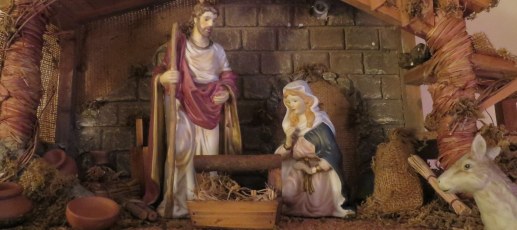
At the beginning of each Advent, our family decorates for Christmas. We put up our Christmas tree and put out our wreath. We hang our garlands and we string up our stockings. We light candles in our windows and we place our Advent calendar in a prominent place. Everything is ready for Christmas except for our Nativity scene. Of course, our stable is out and the shepherds are there. The sheep mill around in the hay and the donkey lies down for a well-deserved rest. Mary and Joseph look into the manger, but they are waiting. The manger is empty and will be until Christmas morning when their baby is nestled snugly into the hay. So during Advent they wait – wait to meet their baby, wait for their Messiah, wait for the fulfillment of all their hopes and dreams.

I have always loved this special time of anxious anticipation. As I wait for Christmas, I never have any doubt that Christmas morning will come, so the delay is sweet, beautiful. It is the same with our wait for Christ’s return. We wait expectantly for the glory and the joy that will be and we know that time will come. For now, though, we wait in the in-between. We are certain of our future, but also faced with the knowledge that mixed into the wonderful creation around us is pain, death and loss. God’s kingdom has been initiated but not yet fully realized.

I was always grateful that I was born on the first day of Advent. It seemed to draw me deeper into the wonder and anticipation of the season. This year, though, I think that God intends for more than just my birth to be linked with Advent. Instead, He plans for my very identity to be tied up in the eager waiting of Advent. Waiting to meet my baby, waiting for my Messiah, waiting for the fulfillment of all my hopes and dreams. So, this Advent, I wait with St. Mary and St. Joseph. Believing that Christ has come. Believing that Christ has risen. Believing that Christ will come again.

“For the Lord himself will come down from heaven, with a loud command, with the voice of the archangel and with the trumpet call of God, and the dead in Christ will rise first. After that, we who are still alive and are left will be caught up together with them in the clouds to meet the Lord in the air. And so we will be with the Lord forever. Therefore encourage one another with these words.” 1 Thessalonians 4:16-18

May 1st, 2010

285547_571084460685_7764516_n

The date is May 1st, 2010. My boyfriend (now-husband) and I have just finished dinner at the Queen of Sheba, one of our favorite restaurants in the Hell’s Kitchen neighborhood of Manhattan. Our stomachs are increasingly full as the injera (bread) expands inside of us and we decide to walk off some of the fullness by taking a trip to Times Square. Even though we have lived in the Bronx for many years, we have never been to Times Square together.

The streets leading to Times Square are unusually quiet, which is pleasant for our date night, but also slightly unsettling. We round a corner and enter the square. It is eerily quiet and empty except for a group of emergency vehicles parked close by on our right. Thoroughly confused, I look up to read the ABC news feed that cycles continuously above us. Nothing there explains the strange desertion of one of America’s busiest places. I lower my eyes and see a crowd of people behind a barricade looking into the square. Then I see another barricade further down the street and turning, I see police setting up another gate blocking the street we have just walked down.

We run towards the nearest barricade and the police help us crawl around the metal gates. We ask them what is happening but they say that they cannot discuss it. Afraid to wait there, we walk quickly north towards Central Park. After walking a few blocks, we encounter another barricade that is blocking traffic and pedestrians from entering the area that we are trying to leave. A fireman at this barricade is more willing to talk: “There’s a bomb.” We don’t stop again until we reach Central Park. Then, using my boyfriend’s phone, we anxiously search the internet to find out what is happening and where it is safe to go next.

Amazingly, thanks to God’s grace and two street vendors, no one was hurt in the attempted bombing of Times Square on May 1st, 2010. I am obviously very thankful for that since my husband and I were there. To be honest, though, I haven’t thought much about that day in quite some time. My memories of it hid somewhere in my brain and made me hesitant to attend First Night and Fourth of July celebrations in big cities but were otherwise forgotten. Then, yesterday, something happened that reminded me of that night.  I was frustrated by the lack of Christian charity in an online conversation about immigrants from Islamic countries and I wrote that I felt we needed to be more forgiving and let go of our hatred. Someone responded to my comment by saying that he would remember to pray for the people who come to kill me and my family and not shoot them.

I’ll admit, I was annoyed by this response, even though I am fully aware that people often post things online that they do not mean. However, as I thought about this man’s response, I realized that I had two conflicting emotions about what he had written. On the one hand, I was angry that someone would even joke about not protecting my family. The situation that the online poster described was not hypothetical for me. Someone already has come to kill me and my now-family. His name is Faisal Shahzad and there is no way around the fact that he wanted me and countless others dead. On May 1st, 2010, the human part of me would have felt nothing but relief if someone had shot Mr. Shahzad before he parked the SUV that contained the bomb.

On the other hand, I am now a mom who has lost her baby. I know how much it hurts to be separated from a child, even if it is just until Heaven. What if Mr. Shahzad had been killed on May 1st and did not know the truth? What if He didn’t have the chance to entrust himself to Jesus, to accept forgiveness for his sins, to secure his eternity? What if he was damned to a forever spent in Hell, separated from the God who created him, who died for him, who loves him? What if God lost his precious child for all eternity? I would never want God to suffer that loss. Never, never! I know only a fraction of the pain that such a loss would cause and it is a truly terrible pain.

Initially, I puzzled over whether or not killing is ever justified. I still do not have an answer for that question, but I think that what God really wants me to know is a lot less practical than that. It is not about anything we can or cannot do. It is not even about what we should or should not do. It is about knowing Him more, seeing His heart in a different way. It is about understanding that while Jesus was a “man of sorrows,” God is a God of sorrows who grieves deeply when His children do not seek Him. He grieves for all of His lost children, even those who want to kill us. God is a bereaved God.

I believe that God wants me to share His grief for His lost children, so last night I prayed for Faisal Shahzad, the man who tried to kill me. I prayed that God will not have to suffer the pain of losing him forever. I prayed that someday, when I am walking around in Heaven, I will meet Mr. Shahzad. I prayed for the chance to hug him and to tell him that I am so very glad to see him in Heaven. I prayed that I will be able to tell him that he is the beloved son of his Father and, therefore, my beloved brother. Please don’t think that my praying this is at all extraordinary. It is easy to pray this for someone who tried to kill you six years ago and failed. The true challenge is praying these things for those who want to hurt us today and it is a challenge that each of us is called to. May we have the strength to meet this challenge!

Trust

p_20161103_121356

I made an appointment today to meet with a Maternal-Fetal Medicine doctor. The idea is that we will develop a plan for any future pregnancies that will limit my risks for another loss. Planning. Having lost my child in a way that results in the death of less than 25 out of 100,000 babies, it seems that planning is completely futile.

I suspect that it was not a coincidence that my loss defied the odds: God knew that I needed to suffer this kind of extremely unlikely loss in order to grow my trust in Him. You see, trust has never been one of my spiritual gifts and one of the ways that I learned to deal with my lack of trust was learning about the likelihood of something happening. If the chances of facing a particular calamity were low enough, then I was able to move on without thinking much about it. If the likelihood of a particular event was fairly high, then I would meticulously plan how to avoid that unwanted outcome. The problem with that approach is that God is not bound by statistics and this means that every negative outcome is a real possibility – even the ones that only carry a risk of .025%.  Noemi’s death helped me to realize that there is absolutely no way that I can create a plan to avoid disaster and, quite frankly, that is scary.

In the face of my own inability to protect myself and my family, the only real option is to trust this God who defies the odds, but does He deserve my trust? Psalm 46 speaks of having faith in God even when everything around us is crumbling and exploding. It portrays God as a “refuge and strength.” It says that He is “always ready to help in times of trouble.” And twice it says “The Lord of Heaven’s Armies is here among us; the God of Israel is our fortress.” So when God says, “Be still, and know that I am God!” (Psalm 46:10), He is not just looking down at us from some lofty mountain and commanding us to trust because we have no other options. Instead, He is right here with us, He is intimately aware of all that is happening, and He is commanding Heaven’s armies to make sure that His will is done.

The question then becomes not whether or not God is worthy of our trust but whether or not we can accept His plan for us. At the very end of the Bible, John tells us the following about the culmination of God’s plan for us:

“Then the angel showed me a river with the water of life, clear as crystal, flowing from the throne of God and of the Lamb. It flowed down the center of the main street. On each side of the river grew a tree of life, bearing twelve crops of fruit, with a fresh crop each month. The leaves were used for medicine to heal the nations.

No longer will there be a curse upon anything. For the throne of God and of the Lamb will be there, and his servants will worship him. And they will see his face, and his name will be written on their foreheads. And there will be no night there –  no need for lamps or sun – for the Lord God will shine on them. And they will reign forever and ever.” Revelation 22:1-5

If that is God’s final destination for me and my loved ones, then I am willing to believe that all of the earlier parts of His plans can be trusted, even if God leads us to places I never wanted to go. As I begin to recreate my own dreams for my life and my plans of how to get there, I will try to hold them loosely, and allow God to shape and mold them into conformity with His plans. And when God leads me to places that terrify me, I will feast my heart on the wonder of what lies ahead of me and allow myself to trust once again since, as a wise priest once told me, God doesn’t ask us to trust Him once and for all – He asks us to trust Him moment by moment.