Grief’s a Stinker

griefs a stinker.jpg

If you have a young girl at home, you’ve probably had plenty of opportunities to watch Disney’s Frozen and to accumulate some favorite (and not so favorite) lines that run through your head at odd moments. Tonight, Princess Anna’s line about her volatile and reclusive sister keeps running through my head (“She’s a stinker!”) because it so aptly describes grief.

Just when I’m feeling pretty good and start to think that I have mastered being a grieving parent, the sorrow pummels me again and I am filled with sadness. Sadness because I miss my child. Sadness because I love the age from eight months to two years and I don’t get to enjoy that time with my second daughter. Sadness because my family will never be all together in this world. Sadness for my friend who is grieving her son’s death. Sadness for all the little ones who we don’t get to know on this side of Heaven. Sadness because change happens before I have appreciated the things that change. Sadness for our world and all of the hatred it holds. Sadness because of evil and sin.

Its a deep, deep sorrow that leaves me standing, mute before God. I can’t offer Him my thoughts because I can’t hold onto a thought long enough to be truly aware of it. I can’t offer Him my words because I don’t have any – I just cling to His words. I can’t even offer Him my feelings because the sadness is so empty that it feels like a colossal hole full of nothingness.

But somewhere in the depths of my soul I hear the words of St Therese of Lisieux saying, “I wish to give all to Jesus, since He makes me understand that He alone is perfect happiness. All!–all shall be for Him! And even when I have nothing, as is the case to-night, I will give Him this nothing . . .”* and I know that, for right now, placing my nothingness in His hands is all that I need to do.


*From The Story of A Soul – The Autobiography of St. Therese of Lisieux as quoted on https://www.ecatholic2000.com/therese/sos18.shtml

Thankfully, God is Not The Little Red Hen

bread

My oldest daughter and I read the classic tale of The Little Red Hen this week. If you haven’t read it, the story is about a hen who decides to plant grain and turn it into bread. She invites her friends to help her with each step of her project, but they never do. Instead, they have a multitude of reasons why they can’t assist her (the weather is too bad, the weather is too nice, they are busy, etc.). When the freshly baked bread finally comes out of the oven, the hen’s friends are suddenly eager to share the fruits of the hen’s labor. The hen, however, won’t share and basically says, “You don’t get anything for free – no work, no pay!”

As my daughter and I discussed how important it is to do our share of work and not to mooch off of other’s efforts, my daughter said, but “Jesus gives us bread that we don’t help to make.” How true!

I read recently that, because God knows everything that ever will happen and everything that ever has happened, He knew everything about us at the very moment when He sacrificed His Son for us. He knew all of the things we would do to let Him down, He knew all of the times we would turn away from Him, and He knew all of the times we would betray Him. Yet, He still offered His Son for us – our living bread.*

Unlike the Little Red Hen, God didn’t require us to work for our bread. Instead, He prepared it, broke it, held it out to us, and said, “Take and eat” (Matthew 26:26). “Take and eat” even though you have done nothing to deserve this bread. “‘Take and eat’ even though I know that you have let me down and will let me down again.’Take and eat’ even though I know that there are times when you abandon and betray me. ‘Take and eat’ because I love you. He prepared our Life and all we have to do is eat!

*Flynn, Vinny. 7 Secrets of Confession. Mercy Song, Stockbridge, MA, 2013.

Unbaptized Little Ones

baptism.JPG

When I was a young teenager, I had a dream one night that continues to impact the way I understand life after death. In the dream, God put me in the vestry of my church and told me to stay there, no matter what happened. After a few minutes, I began to hear explosions outside and, when I looked out the window, I saw a dazzling fireworks display that was partially obstructed by the window. I went to the doorway so that I could see better and, eventually, I took a step outside so that I could see the fireworks that were bursting behind the steeple. Instantly, the church doors slammed shut and flashed with light as if they had been struck by lightning. In that moment, I knew that my dreaming self had been shut out of a relationship with God forever. I was overwhelmed with a gut wrenching, all consuming agony as I wrestled with the realization that I was fundamentally alone and eternally separated from God.  The pain that this knowledge caused me was greater than any physical pain that I could imagine. When I woke up, I concluded that whether or not Hell is full of flames, its greatest horror is separation from God.

This early understanding of what existence is like apart from God, is partly responsible for my desire that all of my children spend eternity with God in Heaven. Unlike the mother of James and John, I don’t ask for them to have any special places of honor in Heaven, but I do beg God that they will reach Heaven, even if they have the lowliest place in there (Matthew 21:20-21).

That is why one of the things that has continued to bother me about Noemi’s death is the fact that her unexpected death meant that she was not officially baptized and this means that we have to trust that God has some not-by-the-book way to take away the stain of sin that she inherited as a member of the human race.

I wasn’t raised Catholic so, until recently, I was not aware that the dominant opinion of the modern Church has been that unbaptized babies, due to the sin that they inherited from man’s fall in the Garden of Eden, go to limbo (In fairness, limbo is envisioned as a place where the unbaptized babies are believed to be completely happy while spending eternity separated from God. For me, this is problematic since, as I explained, I don’t understand how anyone can be completely happy while being eternally separated from God). Although the idea of limbo never became an official Church teaching, it resulted in many unbaptized Catholic infants being denied a mass of Christian burial and being barred from burial in consecrated ground. In fact, there are still people who fervently believe that baptism is so essential to salvation that little ones who die before baptism will never be able to see God. Fortunately for me, the whole time that I have been Catholic the Church has welcomed unbaptized babies into their cemeteries and allowed them to have a special burial mass that entrusts them into the arms of God. More importantly, the Church proclaims that there are “serious theological and liturgical grounds to hope that infants who die will be saved and brought into eternal happiness, even if there is not an explicit teaching on this question found in Revelation…the Church respects the hierarchy of truths and therefore begins by clearly reaffirming the primacy of Christ and his grace, which has priority over Adam and sin” (International Theological Commission, 2007)

This teaching is more in line with my own hopes for my daughter which began to form when I was a protestant, pre-adolescent listening to The 2nd Chapter of Acts sing “Killing Thousands” (a song about abortion). At the time, I was becoming increasingly aware of the importance of accepting Jesus into our lives and so I asked my mother how aborted babies could go to Heaven even though they had not asked Jesus for salvation. She replied that, while the Bible does not say anything about what happens to unbaptized little ones, God made them, loves them, and died for them so we can trust that He would not condemn them to an eternity without Him, nor would He condemn himself to an eternity without them.

The problem for me is, that while I know that I should be satisfied by both the Church’s recent teachings on Baptism and my mother’s response to my question about salvation for unbaptized babies, my need for certainty often rears its ugly head. It drives me crazy that we don’t have a Bible verse that specifically says, “an unbaptized infant, who died at the time that God chose and is deeply loved by God, will be welcomed into Heaven and bask in the presence of God.”

Without any such revelation, my “by-the-book” personality makes me want to be able to say, I baptized Noemi, so she is in Heaven. I so easily fall into the trap of thinking that if I can’t have a direct guarantee from God, then the next best thing is having an “if I do this, then God will do this” kind of formula to follow. However, this is a dangerous preference, for two reasons. First, if God always responded in a quid pro quo way, there would be no room for grace and where would any of us be without grace? Second, what I am desiring is absolutely not my faith – in fact, it is the antithesis of it. My faith is based on the fact that “Grace is totally free, because it is always a pure gift of God.” (International Theological Commission, 2007) I am saved because Jesus chose to save me, not because of anything that I did or did not do. Yes, He calls me to participate in my salvation through things that I do, but my salvation comes only from Him. This is also true for my children: their salvation is from Christ, not from anything that they do or do not do.

So when I think about Noemi’s salvation, it is no different from my own, nor is it different from my hope that my living daughter will be saved. Instead, my hope for all of our salvation rests on faith in the death and resurrection of Christ. It depends on the mercy of a gracious and forgiving God who created us and who loves us – a God who wants us to be with Him so much that He would sacrifice His own child to make that happen. My faith is full of “confidence that what we hope for will actually happen” (Hebrews 11:1), because of who God has revealed himself to be throughout time and Scripture, not because of anything that we do or do not do. My own salvation may be “by-the-book,” but it is no less dependent on the will and mercy of God than Noemi’s salvation that could not be “by-the-book.”

We believe in a loving and merciful God. We believe in an all-powerful God who is not bound by our understanding of things. We believe in a God who sacrificed His own son for the salvation of his created ones. It is belief in this God alone that offers us hope for our salvation and for the salvation of the little ones who died before baptism. We can be grateful that our own lives offer us the opportunity to respond to and to accept that salvation through the rituals that have been given to us, but we should also remember that the rituals, while incredibly important and powerful, are gifts for us, not gatekeepers to Heaven. We should never forget that God can work however He chooses, even if it is not at all “by-the-book.”

Special Announcement


summer

Dear readers,

I very much appreciate your taking the time to read my posts and so I wanted to give you a heads-up about my summer publishing schedule. Starting in June, I will post only on the first Friday of each month. This change will allow me to spend time focusing on two other projects that I am working on and to prepare to teach my daughter’s first year of kindergarten in the fall.

I know that some of you are faithful readers, so if you are looking for a way to nourish your relationship with God on those weeks when I will not be posting, I have a few great books/websites that I highly recommend for you!

For grief related reading:

A Grief Observed by C.S. Lewis

-Grieving the Loss of a Loved One – A Devotional of Hope by Kathe Wunnenberg

Lament for a Son by Nicholas Wolterstorff

For general reading:

Abba’s Child by Brennan Manning

Confessions by St. Augustine

Hind’s Feet on High Places by Hannah Hurnard

-Streams in the Desert by L.B. Cowman

The Jesus I Never Knew by Phillip Yancey

The Screwtape Letters by C.S. Lewis

For biographical information about the Saints and men and women of great faith:

End of the Spear by Steve Saint

Louis Martin: An Ideal Father by Louis and Marjorie Wust

-The Hiding Place by Corrie ten Boom

-www.saintgianna.org

-www.mariagoretti.com

For thought provoking, faith-based writing on current topics and life issues:

Dead Man Walking by Sister Helen Prejean

Letters to Gabriel by Karen Santorum

The Love Dare by Stephen and Alex Kendrick

I look forward to continuing this journey with all of you and hope that each of you has a wonderful summer.

~Ariane

The Battlefield

battlefield.jpg

I just watched two Canada geese, with their feathers ruffled and necks stretched straight ahead of them, chase two other geese who were hoping to get some bread from me. Even though I didn’t have any bread and wasn’t planning to feed any of the geese, I was angry at the two aggressive Canada geese since I dislike all forms of aggression. It is no surprise, then, that I tend to pass over Bible verses that talk about the spiritual battle we are engaged in. Lately, however, I have been thinking about them more frequently and I am beginning to realize how much they reflect our reality. Whether I like it or not, we are living in the midst of a battlefield where the forces of evil are doing everything they can to diminish the glory of God and to destroy His beloved children. Of course, we do not need to fear because God has already won victory through the death of Christ but, in this time between Christ’s death and the final restoration of His kingdom, the battle still rages on.

I recently read something that helped me to realize that, in me, the battle is most apparent in my distorted thoughts and feelings. Too often, I find myself thinking that the world is out to get me, that I am not good enough, that I am deprived of something, or that life is not fair. Not surprisingly, these thoughts quickly lead me to feel depressed, frustrated and bitter. *

I have to remember that the devil is the father of lies (John 8:44) and that He loves to pull me away from God’s truth by getting me to believe untruths about my reality. If instead of believing the devil’s lies, I choose to believe the truth of God’s love and abundant graces, my feelings of depression, frustration and bitterness quickly change to joy and thanksgiving. Ephesians 6:11-12 and 14 says: “Put on all of God’s armor so that you will be able to stand firm against all strategies of the devil. For we are not fighting against flesh-and-blood enemies, but against evil rulers and authorities of the unseen world, against mighty powers in this dark world, and against evil spirits in heavenly places…Stand your ground, putting on the belt of truth…” Of course, the most powerful of God’s truths are found in the Bible: we are His creation (Genesis 1:26; Psalm 139; Acts 17:26-28), we are deeply loved (John 3:16-17; Ephesians 2:4-5; Romans 5:8; Romans 8:38), He is intimately involved in our daily lives (Proverbs 16:9; John 15:5; Romans 8:5), His plans for us are good (Jeremiah 29:11; 1 Corinthians 2:9; Romans 8:28), we serve an important purpose (Matthew 5:13-16; Romans 12:1-5; 1 Corinthians 16:12-20; Acts 1:8), and we are saved (John 3:16; Ephesians 2:1-10; Romans 8).

Ironically, some of the lies that I believe are so simple that I can easily refute them with logic when I spend time actually thinking about them. For example, today I was feeling sorry for myself because of the many “challenges” I face. Yet, when I spent a moment thanking God for the blessings in my life, I quickly realized that the blessings greatly outnumbered the difficulties. In fact, I am so blessed that when I tried to count my blessings, I couldn’t do it!

There are other lies, however, that are much more powerful and can only be refuted by clinging to God’s Truth. One of these is the lie that the story of my youngest daughter, Noemi, is entirely and only sad. While her story absolutely contains sadness, it is saturated with joy! Joy that God chose to create her – a unique person with a beautiful body and her own special soul. Joy that God chose us to be her family. Joy that we had eight months to have her in our lives here on earth. Joy that our belief that she was a tiny person allowed us to accept those months as her life. Joy, unbelievable joy, that she still is, that she brings God glory, and that we will be with her again.

A few weeks ago, I went to Noemi’s grave alone and, for the first time, rather than petitioning God to take care of my baby and allowing me to see her again in Heaven, I found myself thanking Him for Noemi and her story. As I stood there, looking at the ground where I had laid my baby’s body, I was overwhelmed with gratefulness for her life and eternal story. I felt God’s sweet victory which won, not only my daughter’s eternal life, but also my freedom to embrace the Truth and to conquer the lies that the devil had strewn across my battlefield.

*Our emotional struggles are complex. I absolutely believe that the battle between Good and evil is waged largely in our minds and hearts. As a result, our feelings and mood can often be heavily impacted by this battle. That being said, I also firmly believe that there is both a physical and a chemical basis for our mental health. Fortunately, God grants us insight into the biological bases of mental distress through the fields of psychology, psychiatry and neurology. I would never want my words to diminish the importance of these fields in helping those who suffer or to make someone feel that their mental health difficulties are somehow their own fault. 

Greater Than Our Blunders and Sins

Greater than all our failings pic

Today I lost my new friend’s son. Fortunately, a librarian found him wandering around while I diligently watched another little boy who, apparently, wasn’t my friend’s son. Still, I panicked when I discovered my mistake and I am sure that my anxiety didn’t even come close to what my friend felt when she looked around the sing-a-long and didn’t see her little boy. I can easily say that this was my biggest mistake in a long time; however, I made several trivial mistakes this morning, too. Someone aggressively beeped at me, so I must have done something wrong. Then someone else beeped at me because I was driving too cautiously. After I got safely home, I spent hours trying to negotiate with our prescription insurance after I made the mistake of waiting too long to begin trying to refill a medication. All in all, it was a morning full of blunders, not to mention the countless sinful, angry thoughts I had.

I could say that this was an unusual morning, but (apart from losing a kid) it wasn’t. Each day I make multiple mistakes, think terrible thoughts, forget to do things that I should do, and do things that I eventually wish that I hadn’t done. Sometimes these are sins, sometimes mistakes, and sometimes they just don’t measure up to the standards that I have for myself. Each time I make a mistake or I sin, I am reminded that I am an imperfect, finite, blundering sinner. In fact, the truth is that if I didn’t know God and how much He loves me, I don’t know how I could bear myself. Yet, because I do know how much God loves me, I am able to love my flawed self, even on days that I lose my friend’s kid.

You see, God’s love is transformative. It doesn’t overlook our blunders or even our sins. It sees us as we are, flaws and all; however, God’s love “never fails.” No matter what we do or don’t do and regardless of what we mess up or how often we give up, God’s love “always perseveres.” Consequently, when we come to recognize that a perfect God wants to embrace our far-from-perfect selves with His boundless love, we are driven to surrender ourselves to Him.

We see this theme repeated throughout the stories of the Bible. Some of our spiritual ancestors made silly mistakes that were recorded for us so that we could see the way in which God embraces our imperfections and does not allow His plans to be thwarted by them. For example, Joseph dreamed that God would bless him and give him a role that was more important than his brothers. His choice to share these inflammatory dreams with his brothers enraged them and resulted in his being sold into slavery. However, God was with Joseph and, through his mistake, God brought about the very plans that Joseph had prophesied. * Centuries later, Jesus’ disciples tried to guard their Leader’s time by turning away children who were trying to see Him. Rather than turning away from the disciples in disgust, Jesus used their mistake as an opportunity to unveil the tender nature of His love when He said, “Let the little children come to me, and do not hinder them, for the kingdom of heaven belongs to such as these.” (Matthew 19:14)

Other Biblical men and women committed sins that were documented in the Bible. Many of their stories reveal the power of God’s unaltered love. For instance, God’s love did not turn away from a Samaritan woman who had been married to five different husbands and was currently living with a man she was not married to. Instead, it revealed God’s truth to her and used her as a vital instrument in others’ salvation (John 4). His love didn’t shun a man who was afraid to be identified as a follower of Jesus, but made that man the foundation of the Church (John 18:15-27 and Matthew 16:18). The father’s love didn’t even reject a man who “was still breathing out murderous threats against the Lord’s disciples” (Acts 9:1) and who wrote of himself, “I am the worst sinner of all.” (1 Timothy 1:15) Instead, it transforms him into one of the fathers of the church and a man who “was an example for those who would come to believe (1Timothy 1:16).

My guess is that we all have times when we feel guilty or just plain not good enough. Whether it is because we see our innocent human imperfections or because we are overwhelmed by the weight of our sins, these feelings can do one of two things: push us away or draw us in. Too often, we let our sins and flaws push us away from the God and cause us to hide from Him. Like Adam and Eve, our inadequacies and sins make us feel naked and vulnerable before a perfect God. They tempt us to say, like Peter, “Lord…you shall never wash my feet” (John 13:6-8) and they keep us from knowing His boundless grace, love and forgiveness. However, if we lay ourselves bare before God, His loving response to our sins and short-comings can become powerful motivators to run into His open embrace. His unconditional love and forgiveness can remind us that we are His dearly beloved creations, that He made us, and that He is remaking us “fearfully and wonderfully” (Psalm 139:14). It can fuel our desperate longing to “go home” to our Father and cause us to realize that we can’t do this life on our own. It can make us dependent upon Him.

This week, I’ll close with a poem that is based on the story of the Prodigal Son which is found in Luke 15:11-32. The story is, among other things, a wonderful reminder that God is our Father, that He deeply cherishes each of us, and that, no matter what we do, His desire for a loving and intimate relationship with us never wanes. I hope that the words of this poem encourage those of you who already know this love to see yourself through your Father’s adoring eyes, regardless of your failures and shortcomings. If you have not yet run into God’s embrace of love, I hope that my words will nurture your heart’s desire to surrender yourself to the One who calls you Beloved and Whose whole being longs to be reunited with you – flaws and all.

Beloved**

I walk the hard dirt road – alone.

I know no one and no one knows me.

My life is bleak and barren,

My body is weak and weary.

I have nothing in this world,

It is all sin and guilt and shame.

I weep as I wander the road, yet, I hope.

I hope because I am traveling to you

And because I know that you can use a hired hand.

I hope because you pay your workers well:

I have a chance to survive.

As I near your dwelling, you see me approaching.

I am too far to see your face.

I fear it holds anger, hurt and rejection.

But, suddenly you race towards me

And we weep together as you take me into your pure, perfect arms.


*You can read more about Joseph’s story in the Bible. It is found in Genesis.

**Poem by Ariane Sroubek, first published by the Live Poets Society of New Jersey in Of Faith and Inspiration (2003)

Uncomfortable Truths

laundry.jpg

Here’s a little uncomfortable truth about me: even though I don’t play dress up anymore, I still want to be a princess. Not necessarily a poofy gown and glass slippers kind of a princess – that sounds like way too much work. No, I just want to be the kind of princess who has people to take care of everything she doesn’t want to deal with, unlimited financial resources, and a home with every latest convenience. Also, I’d like to be the kind of princess who doesn’t have to struggle to make herself heard in the world, because she was influential at birth. In fact, if I’m really honest, up until the day that my husband became a U.S. citizen and renounced all of his titles, I secretly imagined that my in-laws were really royalty pretending to be commoners. I figured that they could possibly have done this so to ensure that I really love their son and not his status as a prince.  In fairness to myself, I only dwelled on this fantasy when I  had a really bad day (think horrible morning sickness mixed with defiant yet clingy preschooler), but the desire was there.

Now that the United States Citizenship and Immigration Services has forced me to face the reality that I am not, and never will be, royalty, when I find myself having an “I can’t believe this is my life! Where is my fairytale?” kind of moment, I hear this tiny voice in my head saying, “Okay, you aren’t married to the long-lost prince of the Czech Republic, but you are the daughter of the King, which makes you a princess.” The problem is that “daughter of the King” princesses often don’t live very princessy lives. As I recently heard someone say, just look at the life that God gave His son’s mother and you will see that having servants and luxuries are usually not part of the “daughter of the King” deal. In fact, the woman who was “highly favored” (Luke 1:28) by God didn’t have maids, cooks or a nanny waiting in the shadows to meet her every need. As far as we know, she had the responsibility of changing her sons diaper cloths and washing them, too. Presumably, she woke in the middle of the night to nurse her wailing son and I can’t imagine that Joseph could have been much help on that front since they lived in the pre-breast pump era. In addition to all of this, Mary probably got to do all of the other daily tasks that common women did in ancient Isreal. Maybe she carried water from a distant well. She probably had to cook all of the family’s food over not very convenient fires or in primative ovens. Perhaps she even had to make her family’s clothes. Of course, Mary’s unprincessly life would become even more difficult when her Son was rejected by the people of His town and later brutally crucified. Mary’s life was very real, it was relatable, but it was by no means a fairytale!

And then there’s His Son. It would make sense for Jesus to get to live the life of a prince, but no! God had him enter the world at a time that was inconvenient for His parents – He was the long-awaited Messiah but not their long-awaited baby. As an infant, He was a refugee who fled from a king who wanted Him dead. He was rejected by many, lived the life of a wanderer, and even faced a mob that wanted to stone Him. Sure, He had some good friends, but all of them abandoned Him in His time of greatest suffering and one of them handed Him over to be killed. He was wrongfully accused, brutally beaten, mocked, and crucified. Then, He was hastily buried in a borrowed tomb.

The lives of God’s princes and princesses tell me something about God: the things that He deems important about our lives are different from the things that the world thinks are important. This shouldn’t be a surprise to us since Matthew 6:19-20 says, ” Do not store up for yourselves treasures on earth, where moths and vermin destroy, and where theives break in and steal. But store up for yourselves treasures in heaven, where moths and vermin do not destroy, and where theives do not break in and steal.” The uncomfortable truth is that God cares about our lives and He cares about our pain, but, ultimately, He cares most about the salvation of His creation and He is willing to make whatever sacrifices are necessary to bring it about. As a result, He is much more focused on building our love for Him, our love for those around us, our patience, our gratitude, our faithfulness, our trust, and the countless other ways He wants to shape our souls than He is about showering us with earthly comforts.

That might mean that, in order for Cinderella to grow the servant heart that she was made to have, He asks her to spend the rest of her life sweeping ashes and she will never sit on a throne; however, if she lives her simple life well, the Creator of the universe will be pleased and the world will be a better place. It could mean that there is some working man outside of the Beast’s castle that He wants Belle to fall in love with instead of the Beast and, as a result, she will never be the mistress of a castle; however, if she learns to be grateful for the things she does have in her life, she will discover true happiness and satisfaction. Or it might mean that Prince Eric never falls for Ariel and that she has to live a life that is very different from the one she had dreamed of; however, she will eventually find that God loves and cherishes her far more than a voice obsessed prince ever could. Whatever the case may be, God is intimately aware of the details of His princesses’ lives. Often, those lives aren’t very princessy, but He is in the business of using them for amazing good and embracing His plans can bringing us more abiding joy than our worldly dreams of “happily ever after” could.

So on those days when the vacuum backfires and spits dust all over your newly cleaned kitchen, or those nights when you never get past “barely asleep” before being woken by a sick child, or during those times when the one horror that you couldn’t bear to imagine actually happens, remember that you are still the deeply beloved child of the King and His plans for your life are exactly right.

We Are A Resurrection People!

Easter Lily

Ten years ago, my friend and I got to spend Holy Week in Seville, Spain. Each day, we walked into the city to watch the procession of the pasos, which are giant sculptures of the Virgin Mary and Jesus’s passion. Musical bands played somber music and groups of barefoot penitents accompanied the pasos as they made their way through the city streets. As the days passed from Wednesday, to Maundy Thursday, to Good Friday, the excitement and sorrow surrounding the processions seemed to climax. By Good Friday evening, it was difficult to get around the city because each of the main streets was blocked off to make room for one of the processions. On the Saturday after Easter, things were quieter. There were a few more processions, but like the disciples on the day after the crucifixion, the whole city seemed to be waiting and anxiously anticipating Easter and the Resurrection paso.

On Easter morning in 2007, we jumped out of our beds and ran into the city. It was warm and sunny, so I was out of breath by the time we reached the city center; however, I was full of expectation! If the commemoration of Christ’s passion had been so powerful then, surely, the celebration of His victory over sin and death would be absolutely amazing! As we turned onto the street where the procession was suposed to take place we were surprised to find the road almost deserted. Eventually, we found a local resident who told us that the Resurrection paso had been canceled. Now, it is possible that this person did not know what he was talking about and that the procession actually happened at some other place or time in the city; however, for us, the Resurrection paso was “canceled.” As we stood in the street full of disappointment, we could not help but feel that all of the excitement of Holy Week had led only to a great, empty void. After all, why would we ever celebrate Christ’s suffering and death if not for the unbelievable victory of Easter morning? If it were not for the Resurrection, all of our penitence, all of our religious actions, all of our praise would be hollow, meaningless, futile.

In our own lives, we often cancel the Resurrection paso, don’t we? We get so wrapped up in our sins and sorrows that they become the central focus of our lives and even our faith. We repent and confess our sins but continue to allow our feelings of guilt to keep us at a distance from God. We talk a good talk about how selfish, or impatient, or jealous we are but we don’t let go of those identities in the face of Christ’s  salvation. When we grieve, we hold onto our grief by doing things like refusing to reintroduce color into our wardrobes, failing to give the deceased’s room a new purpose, even choosing not to lose the baby weight that reminds us of our lost children! When we have been mentally hurt by cruelty, we become acutely aware of our woundedness and held in bondage by our feelings of victimization. In other words, we live our lives in a way that proclaims why Christ had to die but doesn’t make room for the Resurrection.

Yet, with the dawn of  Easter morning, we are called to lay down our sins and sorrows, to proclaim that they no longer hold any power over us, and to trust in Christ’s amazing victory! We are called to remember that, through God’s great mercy, the sorrow of that first Holy Week ended in joy and victory! On that first Easter morning, Jesus’s grave was empty, but the promises of His Passion were anything but empty! His people would never again be irreconcilably separated from Him. Death would no longer wield any power. His love had paid the cost of all of our sins. Each of the chains that bound His created ones was smashed. As my four year old proclaimed, “When the tomb was empty, God had done everything He meant to do!” Hallelujah!!!

So, no matter what our lives may hold, no matter how high the cost of our discipleship, no matter what we have done or failed to do, no matter who we have lost here on earth, let us never forget that “We are a resurrection people,” (St. Augustine of Hippo) and we live in the power of our resurrected Savior. Let the unshakable joy of our lives be our Resurrection paso that proclaims Christ’s victory to all as we declare with our lips: He is risen! He is risen indeed!

Mother’s Sorrow

OLYMPUS DIGITAL CAMERA

“How long was she conscious?” I asked as the tears filled my eyes and spilled onto my cheeks.

“Are you asking did your baby suffer?” responded my perceptive obstetrician.

I thought of all the questions pounding on my heart: Was the last emotion she knew the panic of suffocation? As her body became bruised and beaten by frantic attempts at CPR, was she aware of it? Did she feel tubes pierce her sides, punching between bones and flesh? Did she wonder where I was and why I was not there to hold her? Did she ask why she was alone, why she was forsaken?

As I nodded my head, my obstetrician gently said, “No, I do not believe that she suffered.” Relief flooded through me.

–              –              –

I’ve never felt particularly close to Saint Mary. In fact, of all the Saints, I tend to be most detached from Mary. There are probably several reasons for this. First, as someone who was raised Protestant, I am wary of any honor that borders on idolatry and there is no other Saint whose veneration often teeters so close to the brink of worship. Second, pride has always wormed its way into my life by disguising itself as a tendency to dislike whatever everybody else likes (think insisting on dresses and leggings when everyone else switched to jeans during elementary school and being disgusted by Titanic when every other girl in my middle school class was swooning over Leonardo DiCaprio). Unfortunately for me, if there is one Saint who everyone loves to love, its Mary which means that I instinctively want to avoid her just because everyone else loves her. Third, I believe that the way that Mary is depicted in art makes it challenging for me to identify with her. For example, it is hard to connect with a woman who looks completely clean, put together, unswollen and calm after giving birth (without pain medication) in a place where they kept animals. Suffice it to say, I gave birth in a clean, animal-free environment with about a dozen doctors and nurses standing by and a nicely placed epidural in my back, yet I don’t have a single picture of me looking clean, put together, unswollen or calm after my children were born. Exhausted but not calm.

However, I recently realized that there was a more fundamental reason that I did not connect with Saint Mary: to really identify with Mary I would have to be willing to be drenched with her sorrows and they are sorrows that my humanness wants to avoid at all costs. Nonetheless, this week I overcame this aversion when I discovered the Catholic practice of meditating on Mary’s Seven Sorrows.  As I pondered the last four Sorrows, I felt that I had been introduced to the amazing Mother of Jesus for the first time. Here was a woman who knew my own pain intimately. In fact, her own pain greatly exceeded my own because, unlike my daughter, her Son absolutely suffered.

Good Friday is an ideal time for all Christians to reflect on the last four of St. Mary’s Sorrows in particular, because it was her Son’s death that caused her so much pain. Consequently, I share my own reflections on these sorrows below.

The Fourth Sorrow is when Mary met Jesus carrying His cross through the streets of Jerusalem to Golgotha. Even as a mother who has begged God to change His mind and restore life to my lifeless child, I can only begin to imagine the desperation and confusion Mary must have felt as she watched her Son carrying the horrible instrument of His own death on His back. How unbelievably awful it must have been to realize that crowds of people hated her Son enough to kill Him. She must have burned with longing to do something, anything, to help Him. She must have been filled with a desire to tear the crown of thorns from His head, to dress His wounds and to clean the lacerations on His back. She must have begged God for His help and intervention, for the protection of her Child. The Stabat Mater describes the scene thus: “Bruised, derided, cursed, defiled, she beheld her tender Child, all with bloody scourges rent. Can the human heart refrain, from partaking in her pain, in that Mother’s pain untold?”

The Fifth Sorrow is when Mary watched as Jesus was crucified and died. Her heart must have shattered as they pierced his hands with crude nails, punching between bones and flesh. I could not see my daughter as she died. In fact,I struggling with my own physical responses to surgery, I did not even know that she was dying. However, my husband watched as the doctors tried to save her and, having talked with him, I can only imagine Mary’s agony as she gazed upon her child’s body, so bruised and beaten. How she must have longed to run to Him, to hold Him as he cried out to His father, “Why have you forsaken me?” She must have wished that she could use her physical touch to show Him that He was not forsaken and to comfort Him. What horror did she know as she gazed up at her son’s face, that was contorted by the pain and terror of His last, gasping breath, unable to do anything at all except to bear witness to His sacrifice? What questions did she ask her God who silently allowed her world and the One in whom she placed her faith to be destroyed?

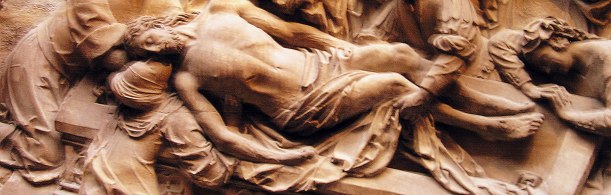
The Sixth Sorrow is when Jesus’s body was taken down from the cross and laid in His mother’s arms. Now, finally, I truly know her heart break for I have shared it with her. I know how anxious she was to wrap her arms around her Son’s broken, bruised body, to bathe His face with her tears, to cover Him with her kisses. I know the way she explored her Child, touched His wounds and tenderly kissed them, trying in vain to make them better. I know how good His weight felt in her arms and how she thought that she would never be able to let go. I know the cruelty of time which slowly marched forward, stealing the warmth, color, and softness from the limbs and the face of her precious Child. And I know the resignation of the moment when she realized that it was time to let go of her Son’s body because the physical changes convinced her that He was no longer there and that it was truly finished.

The Seventh and final Sorrow is when Jesus was buried. There are no words to describe the torment of a parent who is forced to bury their child. Even if Mary was experiencing shock and numbness, she no doubt felt the horror of her loss. While she must have trusted that God would raise her Son as He had promised, as she gazed at the stone rolled across the tomb, she must have also felt the excruciating absence of her Son. Did she, like me, feel that her heart was weeping blood? Did she wish she could catch all of her precious tears in a bottle and save them as tangible reminders of her Son that could sustain her until the day when she met Him again? Did she feel that she was dragging mountains behind her as she turned and walked away from the place where her Child’s body lay? Did she wake during that first night, thinking she heard her Son calling for her or shaking her shoulder, only to discover that she was all alone in the darkness? And how horrible those first moments must have been for her when she woke on Saturday morning and realized anew that her Son was gone and that she had to rise and live another day of torment without her Child!

This Sorrow, this suffocating Mother’s Sorrow, all the result of my sin, of your sin, of the sins of our world.


What Am I Called To Do?

OLYMPUS DIGITAL CAMERA

Last week, I shared about my failure to prayerfully seek God’s plan for my Lenten journey. I realized that, while it is easy to enter into seasons of intense prayer when I am faced with a major decision, I rarely pray for discernment about the daily tasks that God has assigned to me. For example, how often have I asked God how He wants me to feed my child, clean my kitchen, dress for my husband?

When I was trying to choose which college to attend, I spent many days praying for God’s wisdom. One Saturday morning, my father took me on a walk so that we could discuss my thoughts about my future. After listening to me talking anxiously about the pros and cons of my two top choices, he said, “I think maybe God doesn’t care so much about which school you choose – He can work with either one. I think that He is more concerned about what you do wherever you end up going.”

At the time, this idea was simultaneously world-view shattering and a huge relief. Yet, in the years since I have become increasingly aware of the wisdom behind my father’s words. Often, we get hung up on big decisions that we, from our limited human perspective, see as life-altering. Yet God is just as concerned (perhaps even more concerned) with those little decisions we make each day that draw ourselves and others closer to Him. In the same way that we ask God to guide us to the right schools, jobs, spouses, retirement plans, we should be asking Him to guide us through each of the tasks that He assigns to our daily lives.

In light of this, I would like to offer some of the questions that I find helpful in discerning the ways that God wants me to fulfill my various roles. Please know that I am greatly challenged by these questions myself. I offer these questions to you, not because I can honestly answer yes to all (or even any) of them, but because I hope that they will help you to reflect more deeply on the daily tasks that God has assigned to you.

Don’t be overwhelmed by the length of this post! Many of the roles I play will not be applicable to everyone and I encourage you to skip over the roles that you do not play and use only the questions that correspond to the roles that you do. Don’t stop at just answering the questions! Use your answers to guide your prayers for God’s direction in your daily life.

As a child of God, am I: 

  • Ensuring that I have not let anything become more important to me than God?
  • Repenting of my sinfulness and praising God for my salvation?
  • Thanking God for each of the good gifts that He has given to me?
  • Trusting God with all of the scary, painful and difficult parts of my life moment-by-moment?
  • Turning to God in prayer with all of my doubts, questions and anger?
  • Honest with God?
  • Taking time to pray and nurture my spiritual growth through books, retreats, bible studies, etc?
  • Open to changing my plans if God leads me to do something different from what I had expected?
  • Using each of my relationships to share God’s love and story of redemption so that God can be reunited with all of His children?
  • Participating actively in a faith community that proclaims the Gospel in a way that reflects God’s amazing love for all of His created people?
  • Looking for the needs of those around me and making it a priority to meet them?
  • Striving to see the image of God in those around me? Quick to forgive? Slow to anger? Offering love?
  • Participating in activities that bring God glory and focusing on things that are good, rather than allowing negative and ungodly thoughts and activities to take up my time?

As a wife, am I: 

  • Praying for my husband each day and throughout the day?
  • Praying with him regularly?
  • Encouraging my husband in his faith and challenging him to grow spiritually?
  • Making time available to be with and available to my husband?
  • Thankful for the gift that my husband is, for the things that he does for our family, for the amazing ways that I can see God’s craftsmanship in him? Do I let him know this?
  • Gentle when I need to address a problem and willing to accept blame?
  • Quick to forgive?
  • Eager to change the things about myself that breed conflict?
  • Carrying out the tasks that I have agreed to complete around the house as loving gifts to my husband?
  • Making his physical, emotional and spiritual health a priority in our family?
  • Speaking of him with respect when I talk about him with friends, family and our children?
  • Trying to look nice and fulfilling the physical aspects of my marriage vows with excitement and passion?
  • Ensuring that I do not let anything or anyone besides God become more important to me than my husband?

As a mother of a living child, am I: 

  • Praying for my child each day and throughout the day?
  • Praying with her regularly?
  • Helping my child to know and love God?
  • Encouraging and guiding my child on her journey through this world?
  • Nurturing a longing for Heaven in her heart and giving her an eternal perspective?
  • Demonstrating God’s love to her through my own care and enjoyment of her?
  • Keeping her safe physically and mentally?
  • Helping her to use and value the gifts God has given to her?
  • Teaching her to accept the things that God has not made her to excel in with grace?
  • Giving her the academic and social skills to thrive in our society?
  • Modeling how to interact with those around her in a way that reflects God’s love?
  • Providing a clear understanding of right and wrong?
  • Communicating freely and being available to her whenever possible?

As a mother of a child in Heaven, am I: 

  • Thankful for the time that I had with my child?
  • Praying that my child will bring glory to God even through her death?
  • Trusting God for my child’s eternity?
  • Willing to share my pain to help others who are also suffering?
  • Living in the hope of Heaven?
  • Doing everything I can to help my husband, living child and I be reunited with my child someday?
  • Allowing God to teach me, through her death, that life, even when it never breaths outside the womb, is incredibly valuable and was created for Heaven? Open to bearing that life again?

As a daughter, am I: 

  • Praying daily for my parent’s and in-law’s physical, spiritual and mental health?
  • Encouraging them to grow in their faith?
  • Communicating with them regularly and listening to their needs? Trying to meet their needs whenever possible?
  • Expressing my gratitude towards them?
  • Sharing my life with them?
  • Open and honest in my communication with them?
  • Talking respectfully about them in all situations?
  • Doing whatever I can to encourage my living child’s relationship with them?
  • Seeking to learn from them and appreciating their wisdom?
  • Slow to take offense and quick to forgive?

As a sister, am I: 

  • Praying daily for my brother and brothers and sisters in-law?
  • Making communication with them a priority?
  • Opening our home and immediate family to them and welcoming them into our lives?
  • Doing whatever I can to encourage them in their own spiritual walk?
  • Honest with them?
  • Enjoying them and appreciating their many gifts?
  • Accepting their decisions and encouraging their dreams?
  • Willing to meet any needs that arise?

As a granddaughter, am I: 

  • Praying daily for their physical, spiritual and mental health?
  • Prioritizing time with them?
  • Communicating regularly?
  • Sharing my life with them?
  • Honest with them?
  • Encouraging them in their faith?
  • Slow to anger, quick to forgive?
  • Respectful?
  • Gently caring for their physical needs while doing everything I can to maintain their pride and independence?

As a friend and cousin, am I: 

  • Praying regularly for them in general as well as for each of the specific requests they have shared with me?
  • Communicating with them as often as possible?
  • Thinking about their needs and doing what I can to be a blessing in their lives?
  • Being open about my life and faith?
  • Meeting them and encouraging them wherever they may be on their journeys to find Truth?
  • Generous with my time, possessions, energy, money?
  • Assuming their best intentions and quick to forgive?
  • Helping them to raise and care for their children and demonstrating God’s love to their children whenever I interact with them?
  • Available in a crisis?
  • Willing to interrupt my routine to help them with any needs they may have?
  • Forgiving and forgetting?
  • Encouraging them to be the people that they were created to be?
  • Telling them the ways I see God in them and the things I appreciate about them?

As a teacher, am I: 

  • Keeping God and His word at the center of all of my lessons?
  • Instilling a love of learning about God’s creations, the way His world works, and the history of that world?
  • Making sure that I provide a quality education that prepares my child/the children in our Co-op with the skills and knowledge she/they need for the plans God has for them?
  • Encouraging exploration of personal interests, even if I do not share them?
  • Patient and encouraging? Do I speak words of affirmation? Do I work gently with areas that are challenging?
  • Meeting physical, spiritual and emotional needs before expecting learning to take place?
  • Seeing myself as a gardener who tends the flowers God is creating and not as a creator who determines who or what grows?
  • Teaching about the whole world and not just those people and topics that are familiar and comfortable to me?
  • Helping my child develop the skills she needs to address difficult situations and problems rather than avoiding them?
  • Discouraging the need for perfection and encouraging an understanding of effort and process?
  • Willing to let someone else teach my child if God leads me that way?
  • Delighting in the gift of teaching?

As a writer, am I: 

  • Using my words to point others toward God?
  • Genuine, candid and honest in all I write? Living with integrity and striving to allow the lessons I share to take root in my own life?
  • Praying for the people who will read my work and for the wisdom to know what it is that God wants them to read?
  • Refusing the temptation to become discouraged and clinging to the belief that if just one person draws closer to God because of something I have written, then it will all be worth it?
  • Making it a priority to put my best work forward?
  • Taking time to feed myself spiritually before seeking to feed others through my work?
  • Seeking opportunities to share what I write, not because of pride or my need for success, but because I genuinely want others to know the lessons that I share?
  • Willing to express deep, painful, and embarrassing things in order to help others know God in new ways?