Children Raising Children

20190422_115357

I recently encountered someone who does not have children saying that our society’s problems are the result of a bunch of parents who are like children raising their own children. While I get the point of this comment, I couldn’t help but laugh – what new parent hasn’t been discharged from the hospital and thought, “Wait, your leaving us alone with this baby? We can’t raise him, we are just kids ourselves!”?

And that feeling of being an unprepared child only grows from there. Every day. Getting bigger and bigger. Until the night your kid complains about the nasty dinner you cooked and you have a flashback to some of the horrific meals that your mom made you eat. That is the moment when you realize with horror that your own mom didn’t delight in feeding you rubbish, but actually had no clue what she was doing, either (she probably still doesn’t, but we will have to wait about 30 years to find out).

Yup. We are all just a bunch of kids trying to raise our own kids. But you know, for Christians thats a really good thing, because we are God’s kids and as we are struggling to raise up our kids in the way they should go, He is growing us to do the same.

He is teaching us to depend on Him as we juggle our families’ impossible number of wants and needs.

He is revealing our selfishness as we are forced to put the needs of others above our own, over and over again.

He is convicting us of our tempers and forcing us to acknowledge our sinfulness and our need of salvation in ways we never believed possible.

He is teaching us humility when everyone stares at our tantruming children, flailing on the grocery store floor.

He is moving us beyond our judgemental attitudes so that, we feel nothing but sympathy for the poor mom whose kid set off the “Do you have to go potty?” musical toy in the middle of a prayer (after all, our daughter is the one who, on that rare day that we felt brave enough to sit in the front row, whipped out concealed squirt guns and aimed them at the priest during the consecration.)

And, through it all, God is teaching us what it means for a parent to love a child and, by extension, what it means to be children who are loved by our Father.

Yes, we are all children raising children, and for Christians, that is a true blessing!

Why I Hesitate to Say I am Pro-Life

20190130_220536

I was a child the first time I heard 2nd Chapter of Acts sing “My God, they’re killing thousands. Killing thousands, without blinking an eye.” I remember my horror when my mother explained what the lyrics referred to: sometimes people kill babies before they are even born.

That was my introduction to abortion and, as I grew, my lessons continued. Raised an evangelical Christian, I could have been the poster child for the pro-life movement. I helped gather items for pregnancy care center baby showers and organized pro-life walks at my public high school. I had lengthy debates with my grandmother, whose nursing career had shown her the horrors of botched abortions and had influenced her politics. In my spare time, I read books about abortion survivors and mothers like Karen Santorum, who chose to fight for their sick children’s lives at great cost to their own. My carefully crafted, homeschool sexual education curriculum even involved a meeting with the director of our local pregnancy care center.

When, as an adult, I became Catholic, I guess most people assumed that I would become even more unapologetically pro-life, but that is not what happened. Instead, I began to be uneasy about some of the tactics that the pro-life community was using to fight their battle against abortion. At first it was theoretical. I reasoned that screaming at a pregnant mom as she entered an abortion clinic probably did not have the desired effect in most cases. I mean, I am a believing Christian and how often do I let a ranting street preacher have any kind of impact on my actions? Then I started to see my friends, who had previously been open to Christianity, turning away from it because of the loveless way conservative Christians were acting and the hypocrisy they perceived in people who were pro-life in regards to an unborn baby but simultaneously devalued so many other lives (immigrant lives, black lives, criminals’ lives, and the lives of those living in poverty, for example). I too felt their frustration about this political dichotomy. More importantly, I began to grieve as they moved further and further from a saving faith, pushed away by the very people who claimed to speak for that faith.

In the midst of my growing unease about the pro-life movement’s methods, I lost a daughter at birth and then another at 10 weeks gestation. I found myself journeying alongside countless bereaved parents, some of whom had made the heart-wrenching decision to terminate a wanted pregnancy in order to save their child from unimaginable suffering.

I looked at these parents, desperately grieving the loss of their babies, and remembered my own daughters’ deaths. I reflected on the moments when I worried about my older daughter’s suffering. “How long would it have taken for her to lose consciousness without oxygen?” I had desperately asked my doctor. “Would she have known to panic when she couldn’t breathe, even though she had never taken a breath before? Did she have pain as her lungs became so eaten by bacteria that they broke apart and adhered together in all the wrong places? Did she suffer all alone while the NICU team broke her tiny ribs and stuck tubes in her sides to release the air escaping from her ruptured lungs?” Then I remembered the peaceful death that my 10-week-old had, passing away silently in the warmth of my womb, never knowing cold or panic.

With these memories crowding my mind, I look at the parents who chose to try to give their sick babies a more peaceful death and I can’t blame them. If I did not believe that God alone holds our lives in His hands, then I would make the same choice they did. If I did not believe that God would redeem even our most terrible suffering, then I would do anything to limit my child’s pain. I understand these parents, I share their grief from losing a child, and I am angry that Christians, the very people who should be walking with them through their pain, are compounding it by vilifying them as “murderers.”

So all of this is why I hesitate when I am asked if I am pro-life. The question being asked cannot be answered with a simple “yes” or a “no”. It requires nuance and explanation. Yes, I believe life begins at conception. Yes, I believe only God should chose when that life will end and I know that, as difficult as it is, we must speak the truth in love about this. Yes, I am committed to working towards a society in which mothers do not feel the need to abort their babies, where they can be confident that they can meet their children’s needs, where all life is valued. Yes, I am working towards figuring out ways to get kids out of the foster care system and into loving homes. Yes, I am teaching my own children to cherish life and to fight for it.

But, no, I do not believe that the mothers who seek abortions are any greater sinners than I am or that murderer is an appropriate name for them. No, I do not agree with the often hate-filled and judgmental stances taken by many in the pro-life movement – abortion needs to be fought, but it is just one of many battles being waged on humanity and we can’t try to fight it in isolation. We will fail if we keep usinf tactics that might advance us on this one front, but will destroy us on others. No, I do not think that saving an unborn life justifies damning countless other souls by repulsing them with propaganda that is often loveless and aggressive. No, I do not believe that my entire political view can be determined by the single issue of abortion, while I turn a blind eye to the starving, the persecuted and the sick.

Am I pro-life? I suppose some will say I am, some will say I am not. I will say that I am a Christian who is trying to love my God and my neighbor (born and unborn) and whose ultimate hope is that my actions help all of God’s created ones to know His tender love and to one day be united with Him in paradise.

Abandonment

20181207_155205Our little guy just spent some time in the hospital. The place was packed and we had to spend over twenty-four hours in the emergency department while we waited for a room. During our stay, the room across from us was occupied by a school-age boy whose parents were not with him. Instead, various hospital staff members took shifts sitting in the room while he played computer games and fought sleep. When it was time to transport this boy, he became so combative that the hallway was full of adults who were trying to pacify him. In a scene that was reminiscent of a shell-shocked war veteran, he screamed for his mother while being physically restrained by strong security guards. The response he was repeatedly given was, “We are trying to find your mom. We don’t know where she is.”

I don’t know the story behind this young boy’s hospitalization, nor do I know where his parents were. I certainly do not mean to cast judgement on them without knowing the whole story. However, I do know that this little boy was suffering without his parents. His panicked actions reflected his feelings of fear and abandonment. It was heartbreaking to witness.

I also know that a little baby was born 2000 years ago who would also cry out to a parent who was not there for him in the midst of his suffering. As we admire our beautiful creche scenes, its easy to forget that God did not just send His Son for the adoration of Bethlehem but also for the isolation of the cross.  That Son, who God abandoned to death as a ransom for His creation, stretched out His arms to die and called out to His Father: “My God, my God, why have you forsaken me?” (Matthew 27:46)

As a parent, I cannot fathom abandoning my children to death and suffering. However, because God chose us as His children and refused to abandon us to the penalty for our sins, He was willing to give His Son. He sent this Son to be born in a stable filled with dangerous germs, in a land where a king wanted him dead before he was even born, and to a people who would one day choose to crucify him in exchange for the release of a notorious criminal. While the angels sang songs of triumph to shepherds in the fields, God witnessed the birth of His Child, knowing what this victory would require. He gave His son His first breath, fully aware of how He would exhale His last. He looked upon the wonder of Bethlehem knowing that He would turn His back on Golgotha. Yet, still, He gave.

How many of us have, like the young boy at the hospital, felt neglected by those who are meant to love us? How many of us have felt abandoned by God Himself? Yet, if we remember that God refused to abandon us, even at such incredible personal cost, we will be convinced that we are deeply loved and never alone. We might even find ourselves drawn into the warm fellowship that radiated from the stable in Bethlehem so many nights ago, when shepherds and kings, angels and beasts gathered around the little family of the newborn King. We may hear our hearts sing, “This is my family, too.” For by abandoning His Son, God adopted us as His own.

Watchmen

20180827_220214~2.jpg

It has taken me over a year to begin to comprehend this spiritual season of waiting in my life. I am no longer living in the “valley of the shadow of death” so the many Bible verses that speak about God’s comfort no longer soothe my soul as powerfully as they used to. In fact, when the reflection I was reading tonight asked “why do we have to suffer?” I was tempted to stop reading. I have struggled with that question for so long that I want to move on for a while and just let that question exist unanswered. I am not suffering now and I don’t want to explore suffering again in the near future.

At the same time, I have trouble embracing the Bible verses about joy and thanksgiving. I am not saying that I am not thankful, because I certainly have an incredible amount to be thankful for. Instead, what I mean to say is that everything I feel is in relation to the child that I am waiting for and, after so many losses and difficulties, I remain afraid that God might make me wait for him even longer than I hope for. Even more terrifying is the thought that He could choose to use the weak hope that I do have to send me back into a period of suffering. However wrong it may be, this makes it difficult to praise and thank God with abandon. So this waiting time is challenging and it results in my soul waiting for God in a state of apprehension about what is to come and confusion about what lies before me.

As I sought solace in Bible passages that fit this season of my life, I came across Psalm 130 verse 6: “I wait for the Lord more than watchmen wait for the morning, more than watchmen wait for the morning.” When I think about the night watchmen of Biblical times, I imagine that they must have been anxious for the darkness of night to disappear and eager for the light of day to reign. Ezekiel 33 talks about the great responsibility that watchmen had to warn the people when danger approached. It would have been difficult to carry out their task in the complete darkness of a world without electricity. The watchmen must have felt shivers of relief as dawn approached and the first glimmers of light began to take away the sensation that they were peering over the wall into an abyss. But until the morning had fully broken, some apprehension must have remained. The dim light might play tricks with their eyes and make it difficult to rightly interpret what was going on outside the city walls. They must have strained their eyes, trying to see what was coming. When they sensed movement, they must have been filled with frustration and doubt: “It was just a gazelle. No, surely it was too big for that. Yes, it must have been a gazelle, an enemy spy would not linger at such a distance. But what if it is a spy and I don’t blow my horn to alert the people? Yet, what if it is just a gazelle and I wake everyone up for nothing?” It must have been such a relief when light finally saturated the earth around them and they could see clearly and rest with the knowledge that there would be no stealthy nighttime attacks during their watch.

My soul is like the watchmen who waited in the first flickers of dawn’s dim light. It is beginning to see what is coming but can’t be sure. It is waiting for God to bless it with His joy and glory. Today, for me, it is hoping that God’s sunlight will come in the form of a healthy little boy who will grow up to love and bless Him.

Yet, we all are like the waiting watchmen, aren’t we? We are waiting for God’s presence to regain its rightful place in the Church and for healing to begin. We are waiting for God’s justice for the poor and marginalized. We are waiting for God’s love to bind us together as brothers and sisters and to erase the hatred and hostility that poisons our relationships. We are waiting for God to anoint us with the knowledge that answers our thousands of questions “why?” We are waiting to be forgiven for the sins that bring us so much grief and shame that we become consumed with keeping them concealed. Some of us are waiting for God’s presence to be real enough to us that we can truly believe. Mostly, though, all of creation is waiting for the day when God’s kingdom is realized and sin and death are not just defeated but eradicated. We are waiting to see God face-to-face.

While many Bible verses might not fully resonate with us as we wait, the psalmist had one final thing to say to all of us watchmen: “…put your hope in the Lord, for with the Lord is unfailing love and with him is full redemption. He himself will redeem Israel from all their sins.” Psalm 130:7-8

A Chest Full of Moments

Pregnancy after loss

For the past seven months, I have been meaning to write about what it is like to be pregnant after neonatal loss, yet every time I have tried, I have come up blank. Perhaps I am not really processing what is happening to me, since there doesn’t seem to be a cohesive way of making sense of this journey I am on. I suppose it is impossible to fully process and understand events when you don’t have any confidence in where they will lead. In that way, I feel like Mary, treasuring up memories and pondering them in my heart.

So right now, my pregnancy after a loss is like an old chest that I found in an attic that is full of interesting moments that hint at a larger story but don’t fully reveal it.

Some of the moments treasured in the chest are joyful, like seeing the baby’s heartbeat for the first time, choosing a name, making it past the limit of viability and listening to my oldest daughter sing “Yes, Jesus loves me and you!” to the tiny brother she has yet to meet.

Other moments are tinged with sadness, like when strangers see my belly and ask how many other children I have or when someone says how lucky we are to have a girl and a boy. “No,” I think, “We have at least three girls and a boy, the others just aren’t here with us.”

There are also hopeful moments: when I feel brave enough to pick out a coming home onesie, wash the baby’s baptism outfit, or print up pictures for the nursery. There are those few moments every Sunday morning when I think, we made it another week, we might actually be able to do this! And there is the moment the nurse said, “I really think we are going to get you a full-term baby. You’re almost there we just have to get you over this last hump. And I will be so happy for you.”

Sometimes the moments are frustrating, like when I have to choose between going to the hospital again and risking the potential adverse effects of even routine medical interventions, or staying home and risking missing a problem and not making it to the hospital on time to save the baby. In some of those moments I am frustrated with myself, in others my husband is frustrated with me, and in still others I worry that I will make people frustrated with me. In all of them it is my body and my fear that causes the frustration. Which is probably why so many moments also contain guilt – guilt about letting the doctor talk me into doing something I was afraid might hurt the baby, guilt that the house is a mess while I follow the nurse’s instructions to rest, guilt that I can’t do many of the things I love to do with my daughter.

Most often, though, it seems like there are terrifying moments such as going for an ultrasound before feeling regular movement, seeing the tip of the amniotic fluid swab turn a positive blue, and, after what feels like hundreds of false alarms, being told “Your husband needs to be here this time. Have him come now.” Even the benign things that never would have terrified me before now do because they remind me of how we lost our daughter.

Finally, there are those moments that I am too afraid to live yet. Its not a superstitious fear, its a fear of what it will feel like if I embrace certain moments and the baby dies. Some of these moments that are still waiting to happen include the joy of looking around a finished nursery, the excitement of getting to unwrap the crib mattress and carseat, and drifting off to sleep while I imagine my baby being born and hearing his first cry. They also include moments of really bonding with my baby. For the first time, my husband seems to be closer to out unborn child while my relationship with him is on hold.

Perhaps I will reach a point where I am sure enough that my baby will live that I can make sense of all of these moments. Perhaps I will finally be able to imagine him in the clothes I am washing, envision him playing on the floor with my daughter, anticipate hearing his laughter. I had hoped that by 32 weeks I would be able to do this. However, when a baby is lost around the time of birth, it seems that the darkest, scariest time of future pregnancies is right before the hoped for safe delivery, so I may have to wait a while longer.

For now, I will just keep stumbling along, drinking my daily doses of cranberry juice and kefir in a not evidence-based attempt to ward off infection, and trusting God to bring me through to the end. I would like this trust to be voluntary and strong but it is neither. Instead this pregnancy after loss feels as if I am in complete darkness and the only thing that I can do is to cling to the One who claims He can get me to safety as He drags me through the darkness. Still, I am so grateful that I have Him to cling to.


Contractions

I had several great ideas for today’s post – the first in which I was going to be brave enough to write about pregnancy after a loss – but when frequent contractions sent me to the hospital today at just 19 weeks pregnant, all of those ideas became too much to grapple with. Instead, I lie on my couch, hesitant to sit up at the computer. Consequently,  I will use what little battery is left on my phone to share how I have been wrestling with God today (sorry, no nice pictures today).

There are few things that make me feel as out of control as contractions. I feel my body tensing up, riding the wave of tightness and pain, and there is nothing I can do to stop it. However, feeling these sensations at 19 weeks while knowing that, if my body succeeds in pushing out my baby, there is nothing anyone can do to help him, triggers a different kind of helplessness. As I drove myself to the hospital today, I knew that all I could do was pray and trust God. Yet, I also knew that the faith I had to have was deeper than the belief that He would spare my child, because I knew that He might not choose to do that. I knew that I could not have faith in the things we often say to comfort one another (“If you believe hard enough, it will all be okay,” or “God wouldn’t make you suffer loss again”) because those thoughts about God and how He acts simply aren’t true. I knew that there was a real chance that God might chose to take my son to be with Him today, regardless of my prayers. Instead, I had to trust in a God who might do the thing that I prayed fervently that He would not do because that is the living God that I believe in and the God who demands my trust.

Thankfully, the contractions soon eased, the ultrasound showed a healthy baby, and the God I trusted gave me another day with my son. While I pray that He will continue to calm my rebellious body and rescue my child, I am faced with the reality that my faith in Him is not in a God who will necessarily answer my prayers as I want Him to. Instead, the God that I am called (and often dragged kicking and screaming) to trust may have very different plans for me and those I love. It is not my job to know why. My task is only to believe in Him and His goodness no matter what.

My faith is often small. Sometimes, a mustard seed seems too big to compare it to and my weak response of faith is simply, “I have allowed You to bring me to this place.” Yet, I am trusting that through this pregnancy with my precious son, God will grow my faith into one that can move mountains.

So, as I finish this day, I pray the prayer that has become my heart’s cry for this pregnancy: “Spirit lead me where my trust is without borders. Let me walk upon the waters, wherever you would call me. Take me deeper than my feet could ever wander and my faith will be made stronger in the presence of my Savior.” (From Hillsong’s Oceans)

Divine Mercy

divine mercy

I haven’t had much energy this month for writing. Its been one of those “everyone is fed, everyone’s clothes are clean, we did school today, everything else can wait” kind of months. However, I led a small group of women in a discussion of Divine Mercy today and I thought that I might share something that I learned as I prepared for that talk: God is love and His Divine Mercy is the outpouring of that love in response to our needs.

John 4:8 tells us that “God is love.” As incomprehensible as it is, His very being is love. When that Love encounters our many needs, He acts in mercy because that is what love does when it is confronted with need. Our needs are many, so we can see His mercy manifested in countless ways throughout or lives: comfort for our sorrow, peace for our fear, satisfaction of our hunger, justice when we are wronged, the presence of His Spirit to teach and grow us, and so many others.  In all these ways God’s Divine Mercy is manifest in our lives.

Yet, the most pressing of all of our needs, the one that threatens to separate us from God and even to destroy us is our sin. That is why, the most profound way that God demonstrated his Divine Mercy was by sending his Son to suffer and die and then to conquer death and rise again. Because God is love and His love for us is unchanging, He responded to the great need that our sin created by offering this incredible gift of love and mercy.

As we approach Divine Mercy Sunday, I pray that we will all have the time and the energy to spend quiet moments reflecting on God’s great love and Divine Mercy as they were revealed to us on the cross at Calvary and in the empty tomb. And I invite you to pray with me that each person on this earth will be filled with a deep, heartfelt knowledge of God’s mercy, for to be loved so deeply and not know it must be the greatest tragedy of all.

Deliberately Unfulfilled

Deliberately Unfulfilled

“Uh-oh!” cried the teenage girl who was bagging my groceries. Curious, I looked up to see her holding a box of pregnancy tests above her head.

“Is this going to be good or bad?” she asked.

The cashier and the woman behind me froze as if they were holding their breath to see what I did. But, what could I say? I couldn’t tell this girl that I had been trying to hold a living baby in my arms for over two years. I didn’t want her to feel terrible when I told her that, during those two years of trying, I had lost one child at birth, one baby in a ten week miscarriage, and four more little souls before they were big enough to be seen on an ultrasound. I didn’t want to mention that the last box of tests I had purchased at her store had been used to make sure my HCG levels had returned to non-pregnant levels after a loss. Besides that, even if I had been willing to horrify her with the reality of recurrent pregnancy loss, I honestly didn’t know the true answer to her question.

Would it be good if, once again, the test was faintly positive and then faded after several days to nothing? There would be another little soul waiting for me in Heaven but still none in my arms.  And what if it was a clearer positive and I spent weeks gripped in panic and consumed by anxiety about the little life I was carrying but helpless to protect? My husband and I had tabled the question of whether or not I was even ready to endure such fear again because I couldn’t imagine ever being ready again. The reality was that, despite my doctor’s reassurances that it was probably just really bad luck, it seemed like the odds of a happy outcome were terribly low. Still, if the test was negative and I had to deal with yet another month of waiting for something I doubted would ever come and was beginning to lose the strength to try for, would that be any better?

I looked at the teenage girl holding up my box of tests and mustered the best smile that I could. Forcing myself not to think too much, I shrugged and replied, “Hopefully good.” Thankfully, whether she saw the tears sneaking into my eyes or she lost interest, she found something else to talk about.

Of course, while the girl had moved on, I had not. This interaction was not easily forgotten and, when a few days later I had the opportunity to listen to Amena Brown’s Bible Study about Hannah,* I thought, “I feel a lot like Hannah. I might as well listen to it.”

I was very glad that I did. While I have read the story of Hannah many times, I was surprised to hear six little words in the Biblical account of Hannah’s story that I had never noticed before: “the Lord had closed Hannah’s womb.” (1 Samuel 1:6)It wasn’t that God hadn’t gotten around to giving Hannah a child yet or that He hadn’t heard her prayers.  Instead, He had deliberately prevented her from having children. In fact, other translations of the same verse made this abundantly clear. The Holman Christian Standard Bible, for example, translates it as, “The Lord had kept Hannah from conceiving.” Clearly, God deliberately chose to prevent Hannah from having a baby and, by doing so, He chose for her to struggle through a season of wrestling with heartbreak and unfulfilled desire. He actively brought her to a point of sadness that was so deep that her pleading for deliverance was mistaken for drunkenness. This dark stage of Hannah’s life was not a mistake or even a side-effect of something else that God was doing. Instead, it was precisely what God wanted for her at that time.

I realized that the same was true of me. I wasn’t losing my children because God had forgotten me or because He had some other great plan that made us collateral damage. The fact that my arms were still empty wasn’t a mistake and it wasn’t punishment. I was exactly where God wanted me to be – constantly wrestling with heartbreak and unfulfilled desire. I don’t know why God put me in such a dark place, since unlike Hannah, I haven’t yet held the answer to my prayers. Nonetheless, I know that God is deliberately orchestrating my life and, because of that, my answer to the girl bagging my groceries was the truth: I have hope that whether the tests are positive or negative, it will be good.


* You can listen to Amena Brown’s talk here: https://www.youtube.com/watch?v=1moOAN6UJZQ

More


moew

“God, I know, its all of this and so much more, but God right now this is what I’m longing for…Heaven in the face of my little girl.” – Steven Curtis Chapman

I was thinking about the day Mary got to Heaven the other day. In my limited understanding of what reaching Heaven is, all I could think of was the incredible joy she must have felt to see her Son again. I just can’t imagine how it must have felt for her to touch Him and hold Him. Her rejoicing must have been beyond anything we have experienced in this life.

As I was thinking these thoughts, I realized that all of my thoughts about Mary’s assumption into Heaven centered on the very earthly delight of seeing her Son again, not on finding herself in the presence of the Living God or seeing His face which would also have been very really aspects of her joy. This focus on seeing her Son made me consider my own dreams of what it will be like to reach Heaven and I realized they were also completely focused on one thing: reuniting with my daughter.

Its silly, really how I can cognitively know that being brought into the presence of the Creator will be a much bigger deal than wrapping my arms around my dark haired child, but honestly, that act of holding my living little girl would be the most amazing and heavenly thing that I can imagine in this life on earth. Everything else is too far beyond my imaging to even begin to comprehend it because I just can’t imagine anything more wonderful than embracing my daughter in God’s eternal kingdom.

Yet, I thank God that He is far beyond the confines of my simple imagination and that He has prepared wonders for me that I simply cannot fathom – the greatest of which is Himself.

Nativity

christmas.jpg

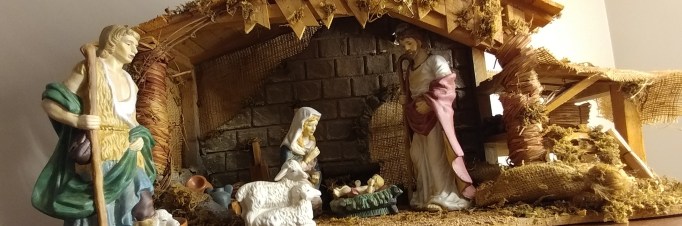
Last week, my husband hurled our Christmas tree out of our living room window. We discovered this method of getting the tree outside last year and it saves us from having to collect needles that were, in previous years, strewn across our living room to the front door. Pushing a tree out the window is also just ridiculous enough to feel liberating. While our tree (which was so dry that it was ready to go up in a fiery blaze) had to be disposed of early this year, our Nativity set reminds us that it is still Christmas for one more day. However, it is a different Nativity scene that I find myself contemplating as I write this.

Unlike the peaceful statues that depict the birth of Christ in my home, the Vatican Nativity scene this year has caused quite a bit of controversy. If you haven’t seen pictures of it, I would encourage you to look it up. Far from the usual tranquil and picturesque scenes that tend to depict Jesus’s birth, this one is chaotic and messy. The walls behind the Holy family appear to be crumbling. The figures are crowded together, so much so that it is sometimes hard to tell which appendage belongs to which statue. When we really think about the Christmas story, we realize that this is how it should be – Christ’s birth was chaotic and messy. His family was “living out of a suitcase” as they stayed in a town that was overflowing with visitors. They were sleeping in a shelter for animals which, no doubt meant that they were enjoying all of the sounds and smells that accompany a quaint barnyard birth. Into this environment that was far from homey, came unfamiliar visitors from diverse social classes. To top it all off, the king already wanted Jesus dead. Certainly there was peace and joy on that night, but that had nothing to do with Jesus’s surroundings. Instead, God Himself reached down and drew peace and joy out of a virgin womb. It was this act of God that brought those two gifts into the hearts of those who worshiped the newborn King who was born to dwell in the desperation, filth and despair of humanity.

While the infant Jesus is at the center of the Vatican’s Nativity scene, the figures that surround the more traditional Christmas statues reveal another aspect of our Savior through the corporal works of mercy that they are performing. In one corner, a woman quenches her neighbors thirst. In another, a man offers dignity to a boy lying naked beneath him by offering him clothes. At the bottom of the scene, with arms outstretched, a figure walks toward an invalid who is bandaged and flushed with fever. Next to them, someone visits a prisoner and, in the far corner, a young man provides burial for a dead body. These figures not only prod us to do what Jesus calls us to do, but they remind us that the irresistible baby lying in a manger would grow up to be a man whose teachings divided families, who demanded that we take up our cross daily, and who told us that to truly serve Him, we must care for others.

 “Then the King will say to those on his right, ‘Come, you who are blessed by my Father; take your inheritance, the kingdom prepared for you since the creation of the world. For I was hungry and you gave me something to eat, I was thirsty and you gave me something to drink, I was a stranger and you invited me in, I needed clothes and you clothed me, I was sick and you looked after me, I was in prison and you came to visit me.’

“Then the righteous will answer him, ‘Lord, when did we see you hungry and feed you, or thirsty and give you something to drink? When did we see you a stranger and invite you in, or needing clothes and clothe you? When did we see you sick or in prison and go to visit you?

“The King will reply, ‘Truly I tell you, whatever you did for one of the least of these brothers and sisters of mine, you did for me.’” Matthew 25:34-40

If you know this passage, you will also know that Jesus’s next words are some of the most terrifying in the Bible:

Depart from me, you who are cursed, into the eternal fire prepared for the devil and his angels. For I was hungry and you gave me nothing to eat, I was thirsty and you gave me nothing to drink, I was a stranger and you did not invite me in, I needed clothes and you did not clothe me, I was sick and in prison and you did not look after me.’” Matthew 25:41-43

Every time I read these words, I shudder. For how much food do I have in my pantry, while there is still great hunger in the world? How easily do I open my faucet that flows with pure water, while children are dying from diseases borne by unclean water? How many strangers have I failed to welcome into the safe, little world that I exist in? How many homeless men and women are shivering on the streets, while hats, gloves, scarves and coats hang unused in my closets? How many times have I been too busy or afraid to offer help to the sick or to those who are cast aside or imprisoned by society? The reality is that I do not measure up well to the standard that Jesus has set before me. However, one of the incredible mysteries of our faith is that salvation is available only through Christ even though we do not deserve it and, yet, Jesus Himself has commanded us to perform great acts of love and sacrifice.

The 2017 Vatican Nativity, portrays both of these truths: that God loved the world so much that He sent His son to be born amidst a desperate people and that He sends us to minister to that world today. It reminds us that faith in Christ has little to do with adoring the little Lord Jesus who made no crying and much more to do with following a man whose message was loud and painful. It forces us to consider the reality that, from birth, our God made His home in the often dirty, fragrant, and chaotic company of the poor, the forgotten, the sinners, the hopeless. It makes us wonder whether or not we have made our homes with Him there, too.